.svg)


.png?width=20&height=20&name=Vector%20(1).png)


.svg)


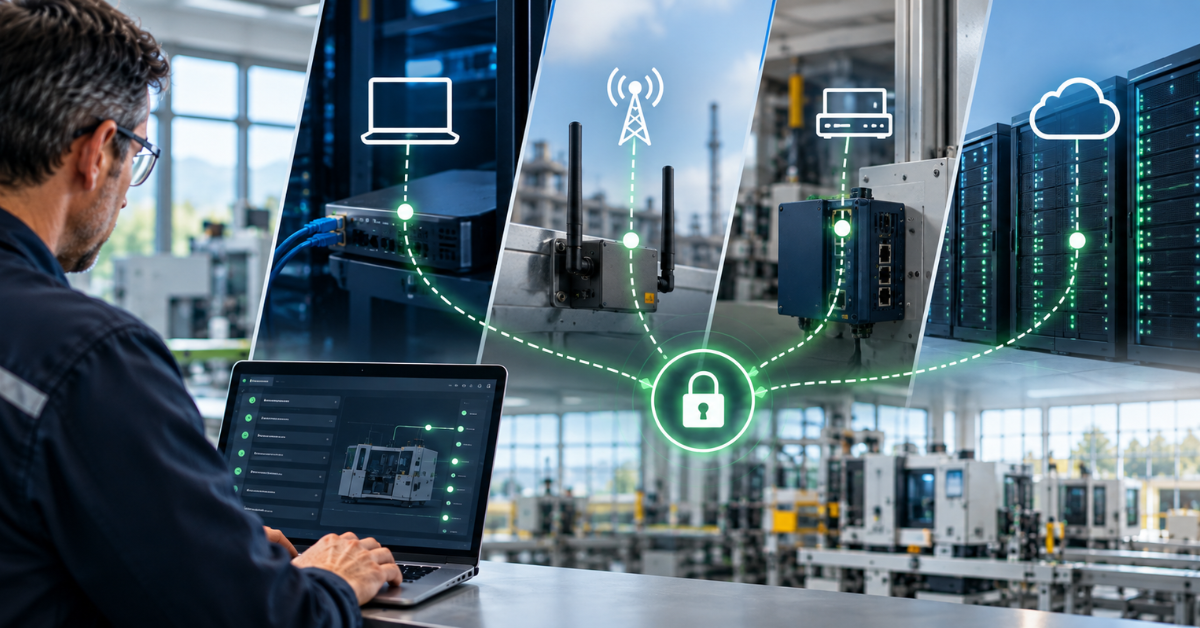
Industrial connectivity isn’t a single choice. Most environments include new machines, existing installations, and legacy equipment, each with different constraints around security, compute, and lifecycle. A practical connectivity strategy has to work across all three.
Below are three common ways machines are connected securely today, and when each approach makes sense.
1. Dedicated Hardware Gateway
A dedicated hardware gateway is a physical device installed in the control cabinet, creating a clear boundary between operational technology (OT) and external networks.
|
Why it’s used
|
Tradeoffs
|
2. Virtual Gateway (Software-Based)
A virtual gateway delivers secure connectivity as software running on an existing industrial PC or edge device, without adding hardware.
|
Why it’s used
|
Tradeoffs
|
3. Legacy Connectivity and Upgrade Paths
Many machines in operation today were never designed to be connected securely. Older controllers, limited operating systems, and customer restrictions can make modern gateway approaches impractical.
Legacy connectivity focuses on bringing these machines into a secure connectivity platform without forcing redesigns.
|
Why it’s used
|
Tradeoffs
|
Choosing What Fits
Most industrial fleets don’t rely on a single connectivity model. New machines, existing lines, and legacy assets often require different approaches, even within the same facility.
Evaluating connectivity at the architecture level makes it easier to select the right gateway per machine, while still standardizing security, access control, and operations across the fleet.
| Connectivity Approach | When It Fits Best | ei³ Gateway |
| Dedicated hardware gateway | Physical isolation, long-lived assets | Amphion |
| Virtual gateway (software) | Modern machines, IPC-based designs | Zethus |
| Legacy connectivity path | Older or constrained machines | Portara |
Why these approaches Secure at Scale
Gateway form factor alone doesn’t determine security. What matters is whether all connectivity options operate within a consistent, layered security model.
ei³ achieves this through its Cyber-Physical System (CPS) Protection Platform, which establishes a unified security framework for how machines, users, and data interact, regardless of whether connectivity is delivered through hardware, software, or legacy paths. This framework brings together edge devices, managed networks, private cloud infrastructure, and IIoT applications into a single, unified security model.
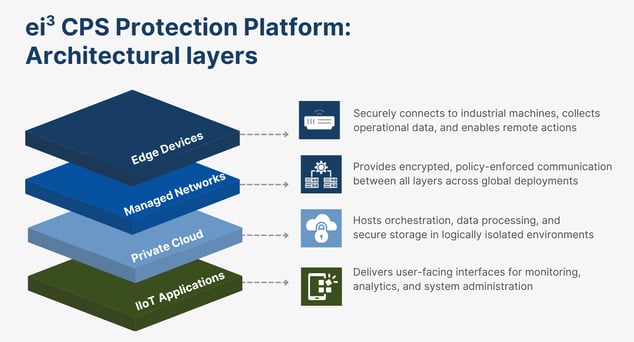
At a high level, this security model includes:
Edge-Level Trust
|
Protected Communication
|
Resilient Operation
|
Managed Networks
|
Together, these capabilities create a zero-trust, defense-in-depth (DiD) architecture that applies consistently across all gateway types, not just the newest machines.




.svg)
.svg)
.svg)