.svg)


.png?width=20&height=20&name=Vector%20(1).png)


.svg)
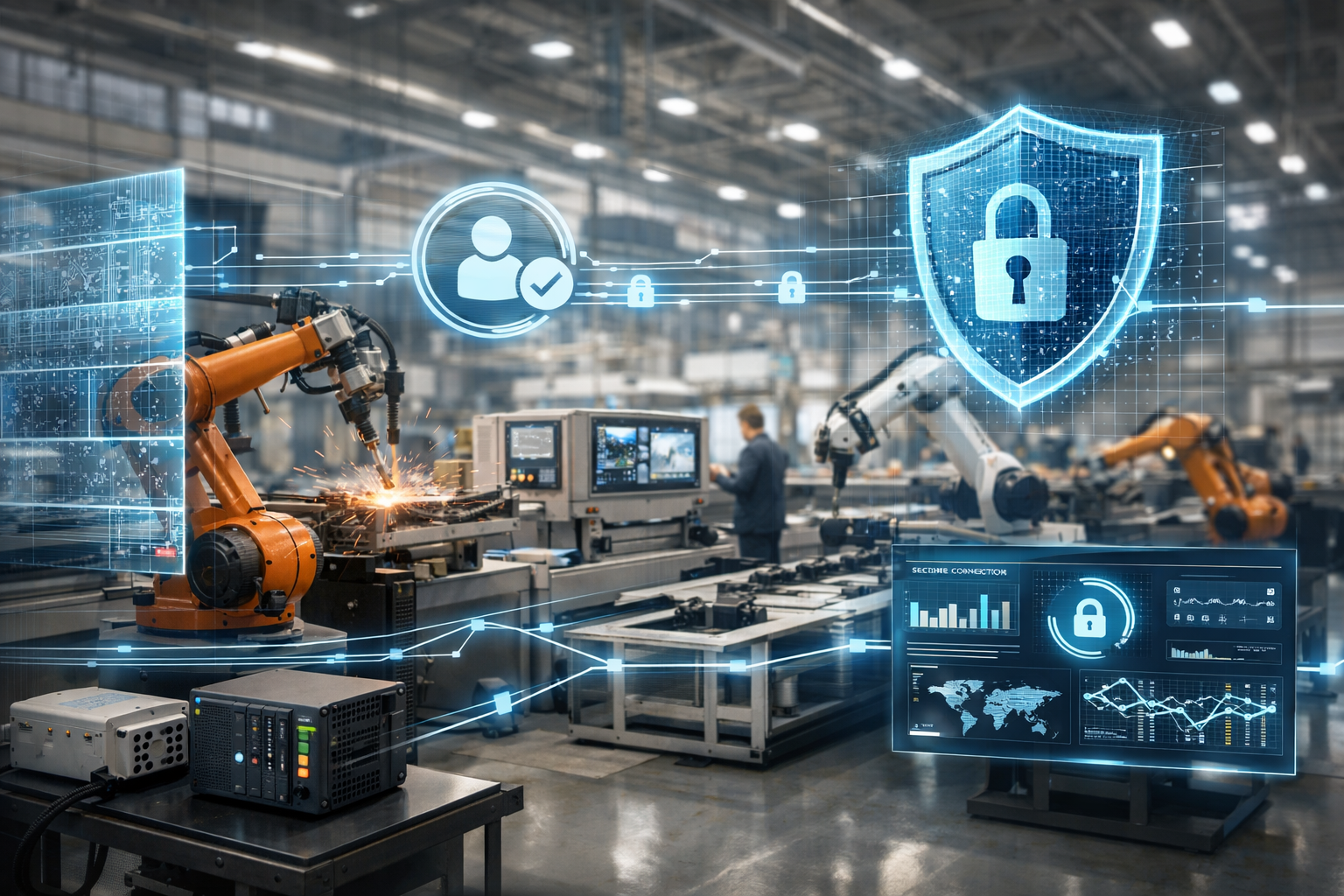

Most manufacturers know they need better cybersecurity for their connected machines. Fewer realize that the approach they're using, or planning to use, may be the wrong one entirely.
The most common mistake is treating industrial cybersecurity as an extension of IT security. It isn't. And when companies try to force that model into a factory environment, projects run over budget, timelines stretch, and sometimes the whole initiative fails. This happens constantly, and it's almost entirely avoidable.
Industrial environments are built differently. The machines are customized. The operating systems are varied. The networks aren't designed with IT compatibility in mind. And unlike a corporate laptop that can be taken offline for a patch, production equipment often can't stop without real operational and financial consequences.
That's the core tension in industrial IoT cybersecurity: the need for stronger security controls, paired with the need to keep operations running without disruption.
Why industrial cybersecurity isn't just IT security with a different label
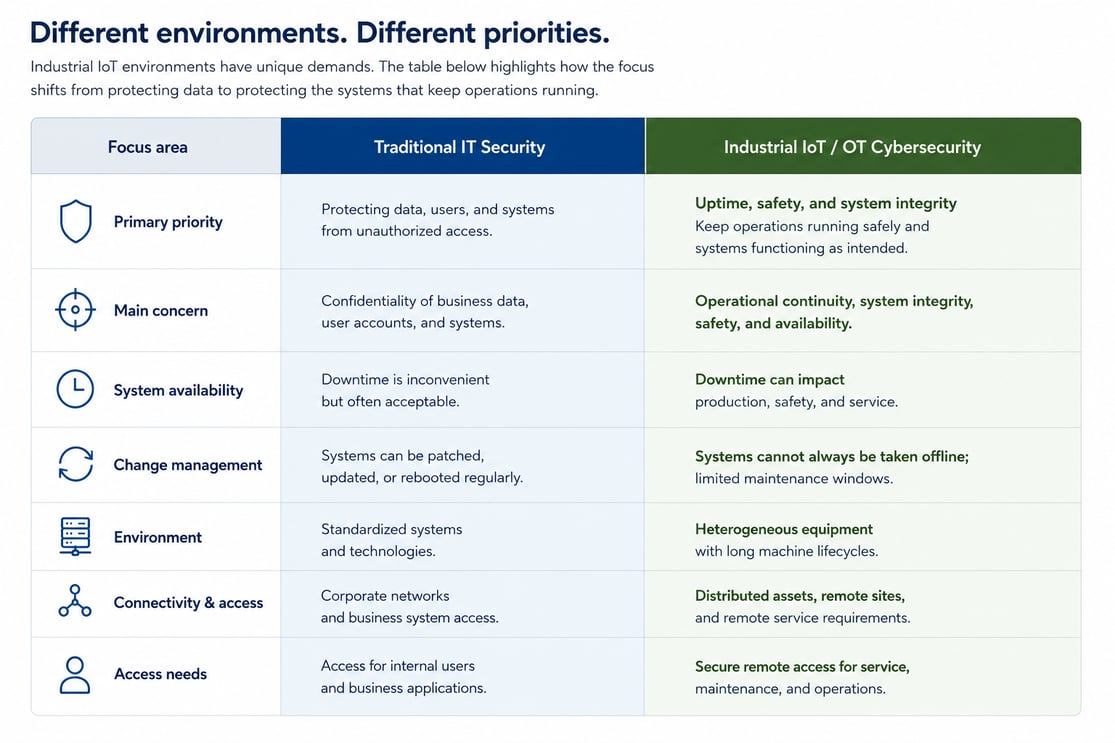
In traditional IT environments, security is primarily about protecting data: user accounts, business systems, confidential information. Keeping things confidential is the first priority.
In industrial environments, the priorities shift. Confidentiality still matters, but uptime, safety, system integrity, and operational continuity are equally critical. Sometimes more so. A security incident that shuts down a production line isn't just a data problem. It's a production problem, a customer problem, and potentially a safety problem.
Industrial systems also come with constraints that IT security tools aren't built for: legacy equipment with long service lives, mission-critical applications that can't simply be rebooted, distributed assets across multiple sites, and networks that weren't designed to integrate with standard cybersecurity infrastructure.
A security strategy that performs well in a corporate network can actively cause problems in a production environment. The tools are often incompatible. The assumptions don't translate. And the cost of getting it wrong is measured in downtime, not just breach reports.
The stakes are higher than they appear
Cyber threats targeting industrial environments are growing, and attackers know exactly why. Uptime is valuable. The pressure to keep machines running without disruption creates leverage, and ransomware operators have learned to exploit it.
For manufacturers, the consequences of a successful attack can include halted production, broken customer commitments, damaged equipment, and in some environments, genuine safety risks.
For OEMs, the exposure is broader. Insecure remote access or poorly governed connectivity can affect not just their own operations, but every customer site where their machines are installed. One weak link in a service architecture can become many incidents.
This risk grows with every new connection. More machines are being connected for remote service, condition monitoring, predictive maintenance, and operational visibility. Each connection adds value, and each one needs to be managed securely.
The answer isn't to avoid connectivity. It's to build connectivity on a foundation that doesn't create new vulnerabilities in the process.
Common risks in connected industrial environments
Industrial IoT environments face many of the same threats as other connected systems, but with higher operational stakes when something goes wrong.
The most common risks include:
⚠️ Ransomware attacks targeting production uptime⚠️ Unauthorized remote access to machines or control systems
⚠️ Exploitation of vulnerabilities in legacy equipment
⚠️ Flat network architectures that allow lateral movement
⚠️ Supply chain and third-party access risks
⚠️ Insider threats or mismanaged user permissions
⚠️ No visibility into who accessed what, when, or why
Many of these risks trace back to treating remote access as a simple connectivity problem. It isn't. Secure industrial connectivity requires control, segmentation, identity management, monitoring, and a full audit trail.
A VPN or remote desktop tool creates access. That's not the same as secure remote service.
What a purpose-built industrial security platform actually does
A Cyber-Physical System (CPS) protection platform is designed for environments where cybersecurity isn't just about protecting data. It's about protecting real-world operations.
A connected machine isn't just a network endpoint. It's part of a production process, a service relationship, and sometimes a safety-critical system. The security model has to account for all of that, not just the digital side.
A CPS platform combines visibility, controlled access, segmentation, monitoring, and operational context. The goal is to reduce risk without degrading the performance and availability of the systems being protected. For industrial companies, this means security becomes part of how the operation runs, not something bolted on after machines are already in the field.
How ei3 approaches secure industrial connectivity
ei3 was built specifically for industrial environments where machines need to be connected, monitored, serviced, and protected across long lifecycles without disruption.
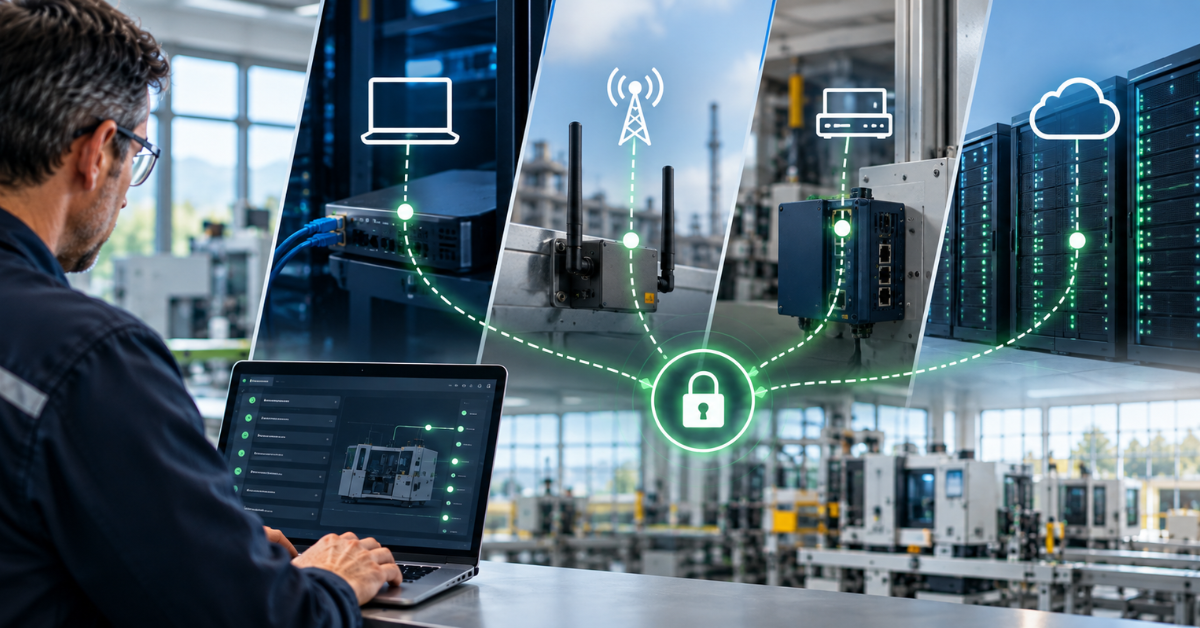
Rather than opening broad access into a plant network, ei3 supports a governed model where authorized users get the access they need, without creating unnecessary exposure to the broader environment. The architecture runs from the edge to the cloud, with security built into every layer.
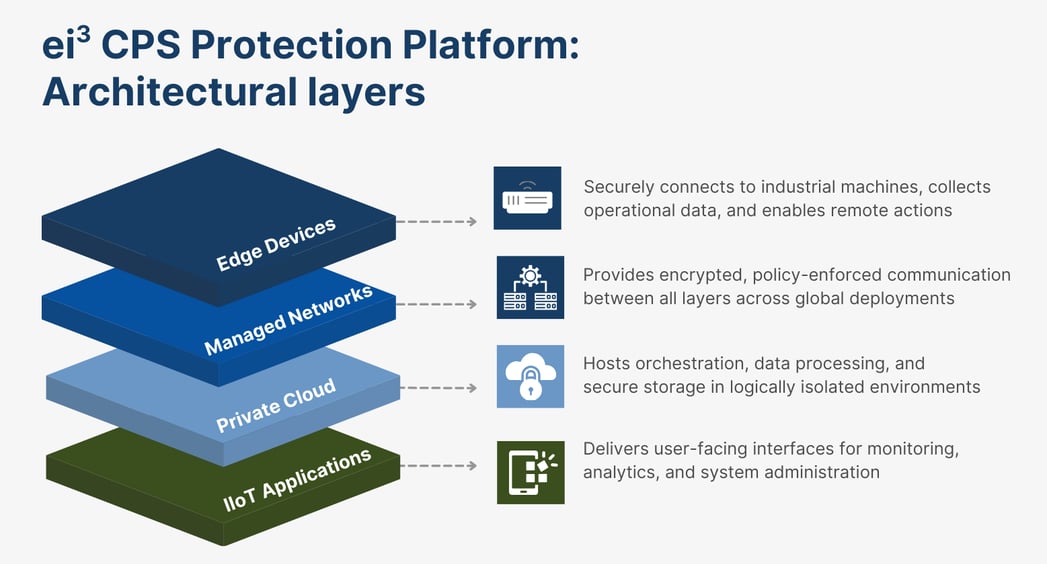
Key capabilities include:
✅ Secure machine connectivity through industrial gateways and virtual options
✅ Encrypted communication between the edge and cloud
✅ Device identity and authentication
✅ Machine-level segmentation
✅ Role-based access control
✅ Session visibility and full audit trails
✅ Continuous monitoring of connected assets
✅ Support for both modern and legacy equipment
The result is an industrial IoT environment that can scale without depending on unmanaged, inconsistent, or overly permissive access methods.
Remote access is the starting point, not the finish line
Most industrial cybersecurity conversations begin with remote access, and for good reason. OEMs need to support machines in the field. Manufacturers need vendors, technicians, and internal teams to troubleshoot efficiently. Good remote service reduces downtime and lowers support costs.
But remote access has to be controlled.
Secure remote access for industrial equipment means the right user gets to the right machine, at the right time, for a documented reason, with a complete record of what happened during the session. It should never mean open-ended access to a plant network.
This is what separates a purpose-built industrial remote service model from a general-purpose connectivity tool. The goal isn't just connection. It's access that supports service efficiency, cybersecurity, and accountability at the same time.
Meeting compliance and customer requirements
Cybersecurity expectations are tightening across the industry. Manufacturers and OEMs are being asked to demonstrate stronger security practices by customers, partners, insurers, and regulators alike.
Frameworks like the EU Cyber Resilience Act are pushing companies to think carefully about secure product lifecycles, vulnerability management, asset visibility, and documentation. Not as a future concern, but now.
ei3 helps organizations meet these requirements by providing better visibility and control over connected industrial assets. That includes:
🔒 Asset inventory and connectivity visibility
🔒 Secure lifecycle support for connected machines
🔒 Risk and vulnerability management practices
🔒 Audit-ready reporting and documentation
🔒 Controlled access and activity records
🔒 Security capabilities that support regulatory or framework-driven requirements
For most companies, compliance isn't just a checkbox exercise. It's about being able to demonstrate, to customers, auditors, and partners, that connected machines are being managed responsibly.
Legacy equipment belongs in the security strategy too
One of the most persistent challenges in industrial cybersecurity is that much of the installed base was never designed for today's connected world. Industrial equipment regularly operates for decades. A full infrastructure replacement isn't realistic for most organizations, and in many cases, it isn't necessary.
A practical industrial cybersecurity strategy has to work across the existing fleet, not just new machines. ei3 supports connectivity for both modern and legacy equipment, making it possible to add secure remote access, monitoring, and visibility without requiring a complete infrastructure overhaul.
Security that only applies to new assets leaves most of the operation exposed.
The business case goes beyond risk avoidance
Industrial cybersecurity is usually framed as risk reduction. That's true, but it understates the value. A secure industrial IoT foundation doesn't just prevent bad outcomes. It enables better operations.
Organizations with the right foundation in place can:
✅ Reduce downtime and operational disruption✅ Improve remote service efficiency and response times
✅ Protect intellectual property and operational data
✅ Detect unusual activity earlier, before it becomes an incident
✅ Meet compliance and customer security requirements with confidence
✅ Build credibility with customers and partners
✅ Scale connected machine programs without introducing new risk
For OEMs, this can also become part of the customer value proposition. Secure connectivity and remote service are no longer just internal capabilities. They are increasingly part of how machine builders differentiate their service model, support their installed base, and build long-term customer relationships.
Security isn't the barrier. The wrong approach is.
Industrial IoT creates real opportunities: remote service, condition monitoring, performance optimization, predictive maintenance, advanced analytics. The value is real and it's growing.
But none of it scales safely if the connectivity underneath it isn't secure.
The companies that get this right aren't the ones that treat security as a constraint. They're the ones that treat it as part of the architecture: built in from the beginning, designed for the industrial environment, and capable of protecting both the physical and digital sides of the operation at once.
That's what secure industrial connectivity looks like. And that's what makes everything else possible.
ABOUT THE AUTHOR
Adam Griffen is the Cybersecurity & Compliance Manager at ei3, bringing over 10 years of experience across automation, product management, and industrial digital security. He has worked in roles ranging from operator and technician to engineer and product manager, giving him a practical understanding of the cybersecurity, compliance, and operational challenges manufacturers face. Adam also serves as Chair of OMAC’s Digital Transformation Workgroup, contributing to initiatives involving PackML and OPC UA standards.

Adam Griffen
Connect with me on Linkedin
See how ei3 protects connected machines
A technical overview of the security architecture protecting connected industrial operations, from the plant floor to the cloud.



.svg)
.svg)
.svg)