.svg)


.png?width=20&height=20&name=Vector%20(1).png)


.svg)
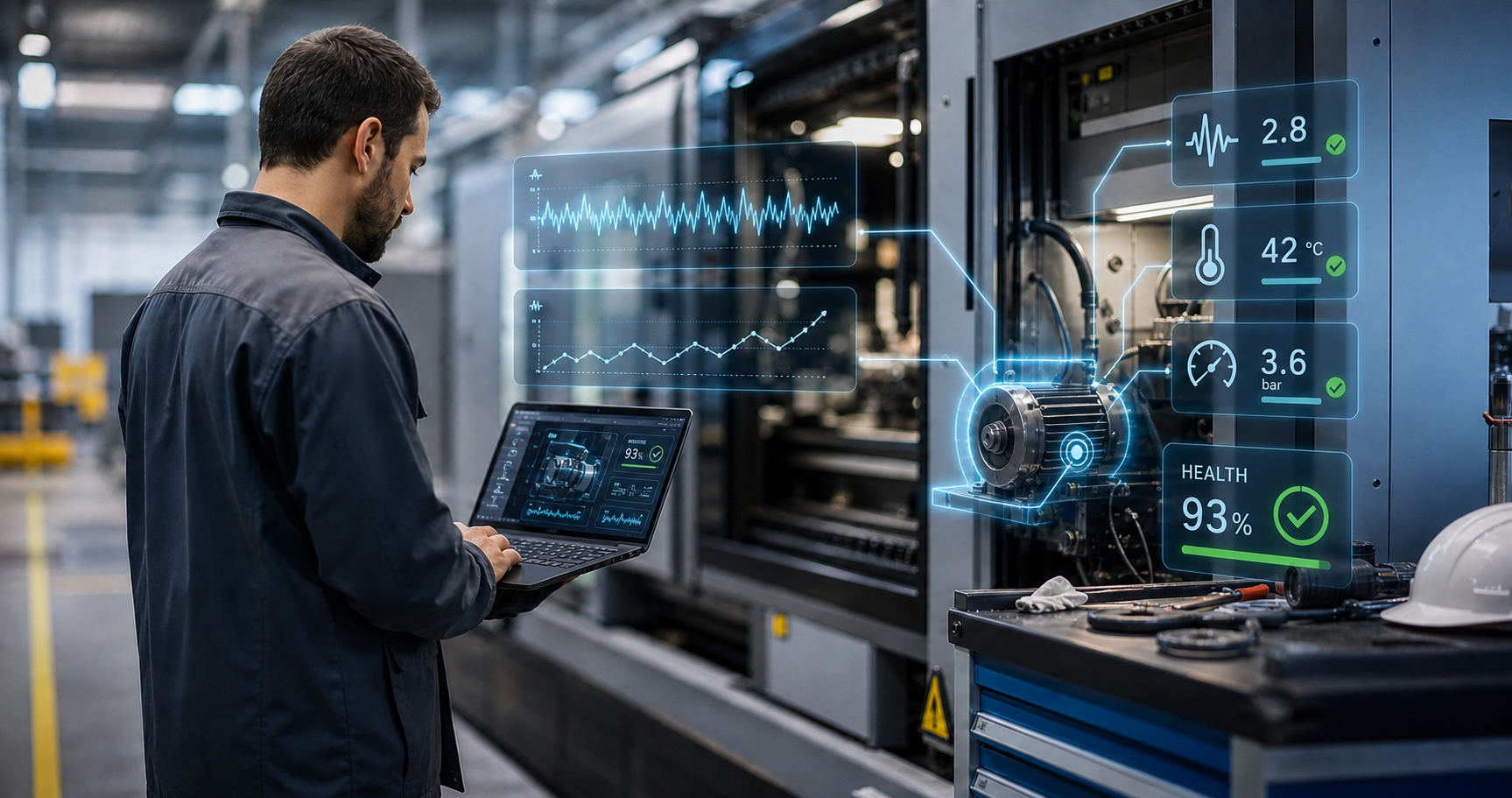

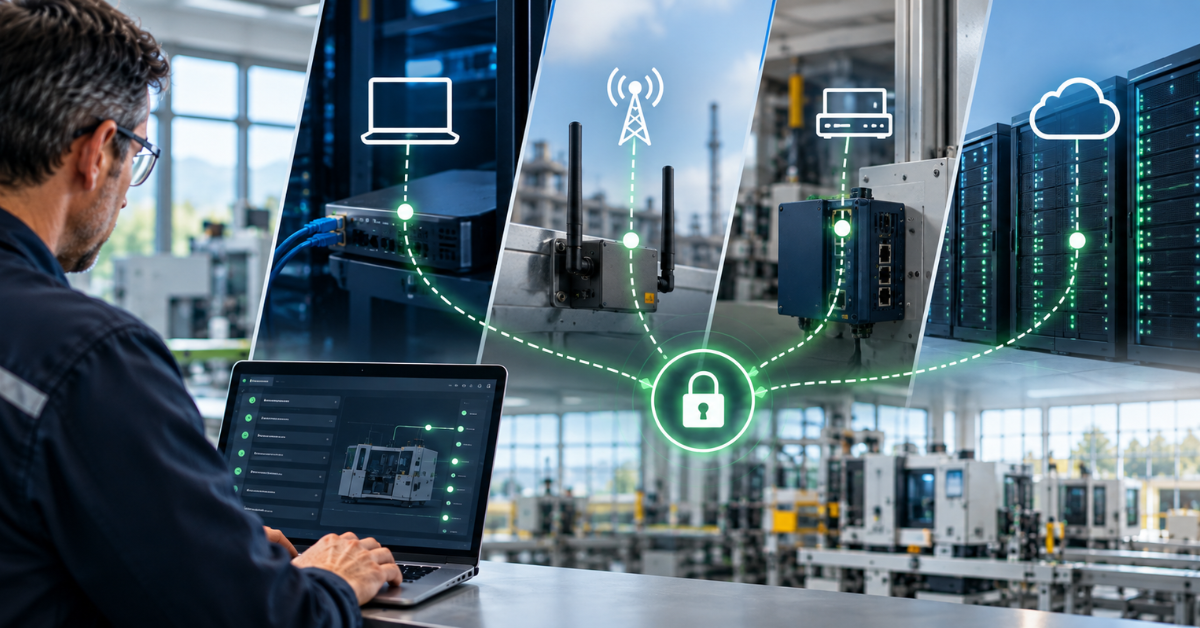
Remote access is often the first step in a connected machine strategy, but it should not be the last. The bigger opportunity is turning that access into better governance, useful machine data, scalable service workflows, and long-term connected machine value.
For many machine builders, remote service proves the value first: service teams connect remotely, diagnose problems faster, reduce site visits, and support customers more efficiently.
But working in Customer Success, we see what happens next. As remote access expands across more machines, customers, and regions, the conversation shifts from "can we connect" to "what should we do with the connection." The OEMs who treat connectivity as a strategic decision today are the ones best positioned to deliver on IIoT tomorrow.
That distinction matters. A connected machine strategy needs to be phased carefully. The most successful OEMs prove value with a focused rollout first, then build toward machine data, monitoring, and analytics over time.
Key takeaways
|
Remote access solves the first problem
When a customer has a machine issue, remote access can help service teams respond faster. Instead of sending a technician onsite immediately, the OEM can connect remotely, review the issue, guide troubleshooting, or determine whether a visit is actually needed.
For many OEMs, this is the right place to start because the value is practical and immediate. A focused remote service pilot can prove that connected machines help both the OEM and the customer.
Is your Remote Access Program ready to grow?
A useful way to evaluate connected machine maturity is to look at what your current remote access program does today, and what your business may need next.
| If your current platform is mainly used for… | Consider whether you also need… |
| Remote PLC troubleshooting → | Centralized access governance and session visibility |
| Gateway-based remote access → | A path to machine data and IIoT applications |
| One-off service connections → | A scalable model across customers and equipment fleets |
| Basic monitoring or data logging → | Role-specific dashboards, alerts, trends, and reports |
| Customer-specific access setups → | A repeatable deployment and approval model |
| Installed-base connectivity → | A modernization path across mixed machine environments |
| Remote service support → | A broader connected machine strategy |
Start with the immediate need
When we onboard OEMs, one of the most important things we do is narrow the scope.
That can feel counterintuitive. Many teams are excited about the long-term possibilities of connected machines: dashboards, alerts, predictive maintenance, customer portals, AI, advanced analytics, and fleet-wide visibility.
Those are valuable goals, but they should not all be treated as phase one.
A strong first phase usually answers a very practical question: What is the urgent problem we need connected machines to solve first? For many OEMs, that problem is remote service. For others, it may be basic machine visibility, alarm review, warranty support, replacing an existing remote access setup, or proving connectivity with a specific group of customers.
A good phase-one scope usually defines:
- Which machine models are included
- Which customers or sites are included
- Which service users need access
- Which access rules are required
- Which data points matter immediately
- What success looks like after the pilot
- What should be intentionally left for a later phase
That last point is important. A successful rollout is not only about deciding what to include. It is also about deciding what not to include yet.
One thing I have learned from onboarding connected machine programs is that OEMs and their customers do not always define success the same way. While OEM teams may initially focus on connectivity, access, or technical capabilities, customers are often looking for practical outcomes such as faster support, better visibility, and confidence that help is available when they need it.
The most successful programs I have seen are usually the ones that start with a clear business problem, prove value quickly, and then expand deliberately as new opportunities emerge.
Build the governance model before access becomes fragmented
Remote PLC troubleshooting is often one of the clearest starting points. A technician needs to connect, diagnose the problem, and help the customer get back up and running.
But as remote access scales, the operating model becomes just as important as the connection.
OEMs need to manage who can connect, which machines they can reach, when they can access them, and how that activity is tracked. This becomes especially important when different service teams, customers, regions, or equipment types are involved.
A scalable remote access program should support:
- User roles and permissions
- Machine-level access control
- Customer- or site-specific access rules
- Session visibility
- Approval processes where needed
- Repeatable access management across the installed base
From a customer success perspective, this is where good onboarding matters. The technology may allow many configurations, but the program needs a clear operating model.
Who owns user access? Who approves new users? How are customers informed? How are service teams trained? What happens when machines move, customers change, or new regions are added?
These questions are easier to answer early than after the rollout has already become inconsistent.
Use machine data to answer real service questions
Many connected machine programs begin with gateway-based remote access. The first objective is to establish a secure connection to the equipment.
That connection can become much more valuable when it also supports machine data.
Once data is available, OEMs can begin moving beyond reactive support. Instead of waiting for a customer to report an issue, teams can monitor machine conditions, review trends, set alerts, and identify patterns across equipment.
In some cases, we've worked with OEMs that initially approached us looking only for remote service access. Within a few months, those same teams began using machine data to support warranty discussions, customer reporting, and proactive service initiatives. What started as a service connection gradually became a source of operational insight for both the OEM and the customer.
Machine data can support:
- Remote diagnostics
- Performance monitoring
- Uptime and downtime analysis
- Maintenance planning
- Quality tracking
- Energy visibility
- Parts and service optimization
- Customer reporting
- Future analytics and AI use cases
The important onboarding question is not “How much data can we collect?” It is:
Which data will help the team make a better decision?
Starting with too much data can slow adoption. Starting with the right data helps teams build confidence.
That also means thinking about who will use the data. A service technician may need alarms, event history, and diagnostic context. A service manager may need fleet-level visibility, recurring issue patterns, and response trends. A customer may need uptime, productivity, quality, or energy insights. Product and engineering teams may need performance data that helps improve future machine designs.
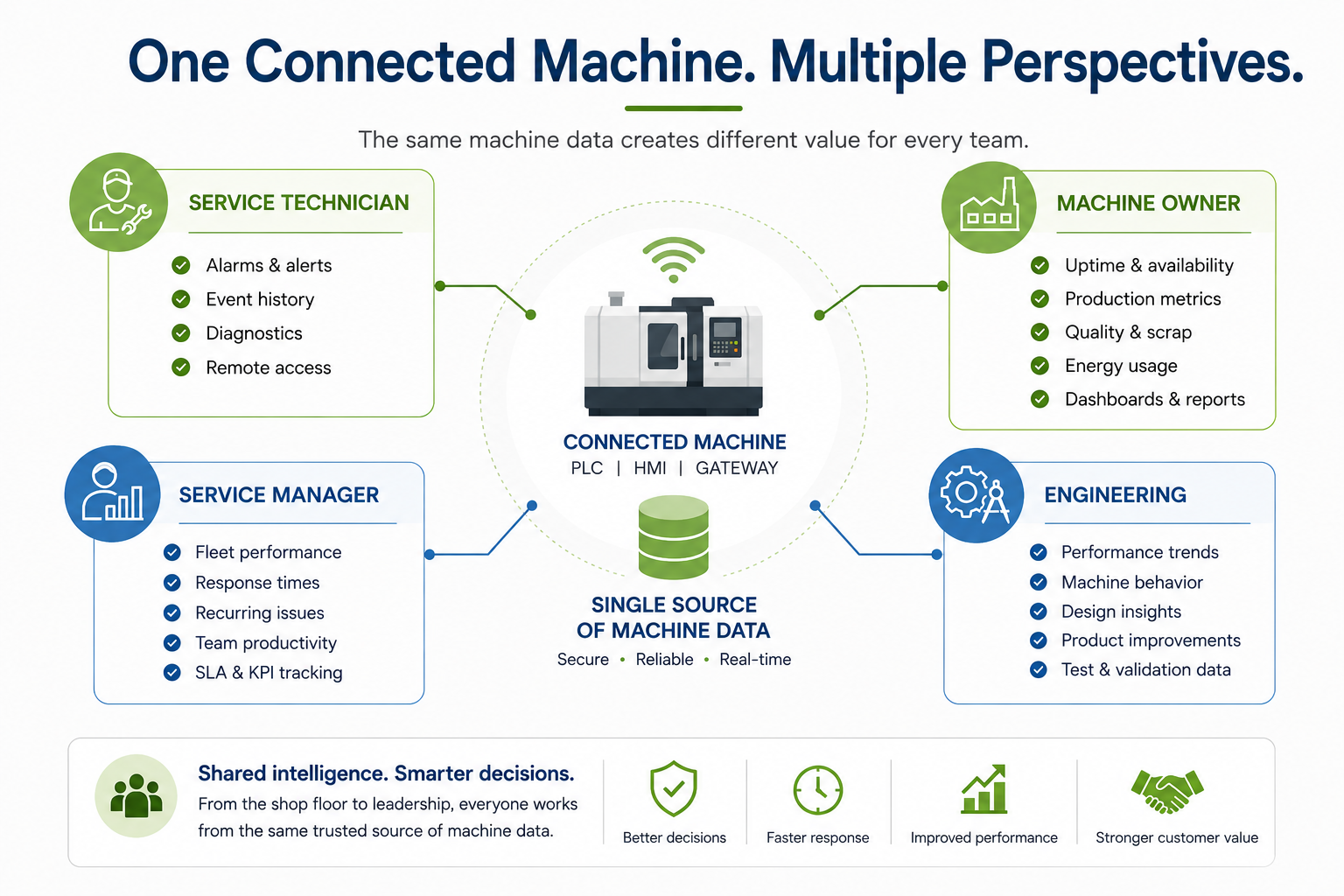
This is where many OEMs begin to see that connected machines are not only a service tool. They can become a shared source of intelligence across service, operations, engineering, and customer success.
Connectivity is not always the customer’s definition of success
Another pattern we see during onboarding is that the original technical goal often evolves once real users begin working with the platform.
A program may start with a straightforward objective, such as validating secure remote service connectivity. But for the customer, success may quickly become more practical: can their team use the platform confidently, access the information they need, and get support more efficiently?
Another OEM may begin with the technical goal of replacing existing remote access infrastructure. But the business objective behind that project may be broader: reducing support friction, standardizing the service model, and creating a more sustainable way to support machines remotely.
In other cases, the first conversations may focus on connectivity and application setup. As the rollout develops, the real work becomes operational adoption: how the platform fits into daily processes, existing systems, customer workflows, and the way teams already support equipment.
For OEMs that are further along, secure connectivity and machine data collection can also open the door to new customer-facing value. What begins as a technical connection can evolve into reporting, energy visibility, performance insights, or other services that help end users understand and improve their own operations.
That is why it is so important to define success in business terms, not only technical terms. Connectivity matters, but the value comes from what that connection makes possible for the OEM, the service team, and the customer.
Make deployment repeatable without ignoring customer realities
Customer-specific access setups are common in the early stages of remote access. One customer may require a certain approval process. Another may have different network requirements. A third may only allow access under specific conditions.
Some variation is unavoidable. Industrial environments are complex.
But if every deployment is treated as a unique project, the program becomes difficult to manage.
OEMs need a repeatable approach that can still adapt to customer requirements. That means having a clear deployment model, consistent security architecture, standard user management, and a defined process for expanding across machines and sites.
A repeatable model helps OEMs move faster while giving customers more confidence. It also helps internal teams align around a standard way to sell, deploy, support, and expand connected machine programs.
In practice, this is one of the biggest differences between a remote access tool and a connected machine program. A tool may help you connect. A program helps you scale.
Bring the installed base into the roadmap
New machines are only part of the opportunity.
Many OEMs have a large installed base already operating in the field. Those machines may include different generations of controls, protocols, customer environments, and levels of connectivity readiness.
The question is not simply whether new equipment can be connected. The question is whether the OEM has a path to bring existing machines into the connected service model over time.
Installed-base modernization can help OEMs:
- Extend connected services to machines already in the field
- Standardize remote access across older and newer equipment
- Improve visibility into existing assets
- Create new service opportunities
- Support customers without requiring full machine replacement
- Build a more complete view of machine performance across the fleet
Not every machine needs to be modernized at once. Teams can start with the highest-value equipment, the most strategic customers, or the machines where remote access and data will create the clearest operational benefit.
Plan for advanced intelligence after the foundation is working
As remote access and machine data mature, OEMs can begin asking a more advanced question: How can connected machine data help teams work smarter?
We are often asked about AI early in the conversation. While the opportunities are exciting, we've found the most successful projects focus first on connectivity, governance, and useful machine data. AI becomes much more valuable once those foundations are in place.
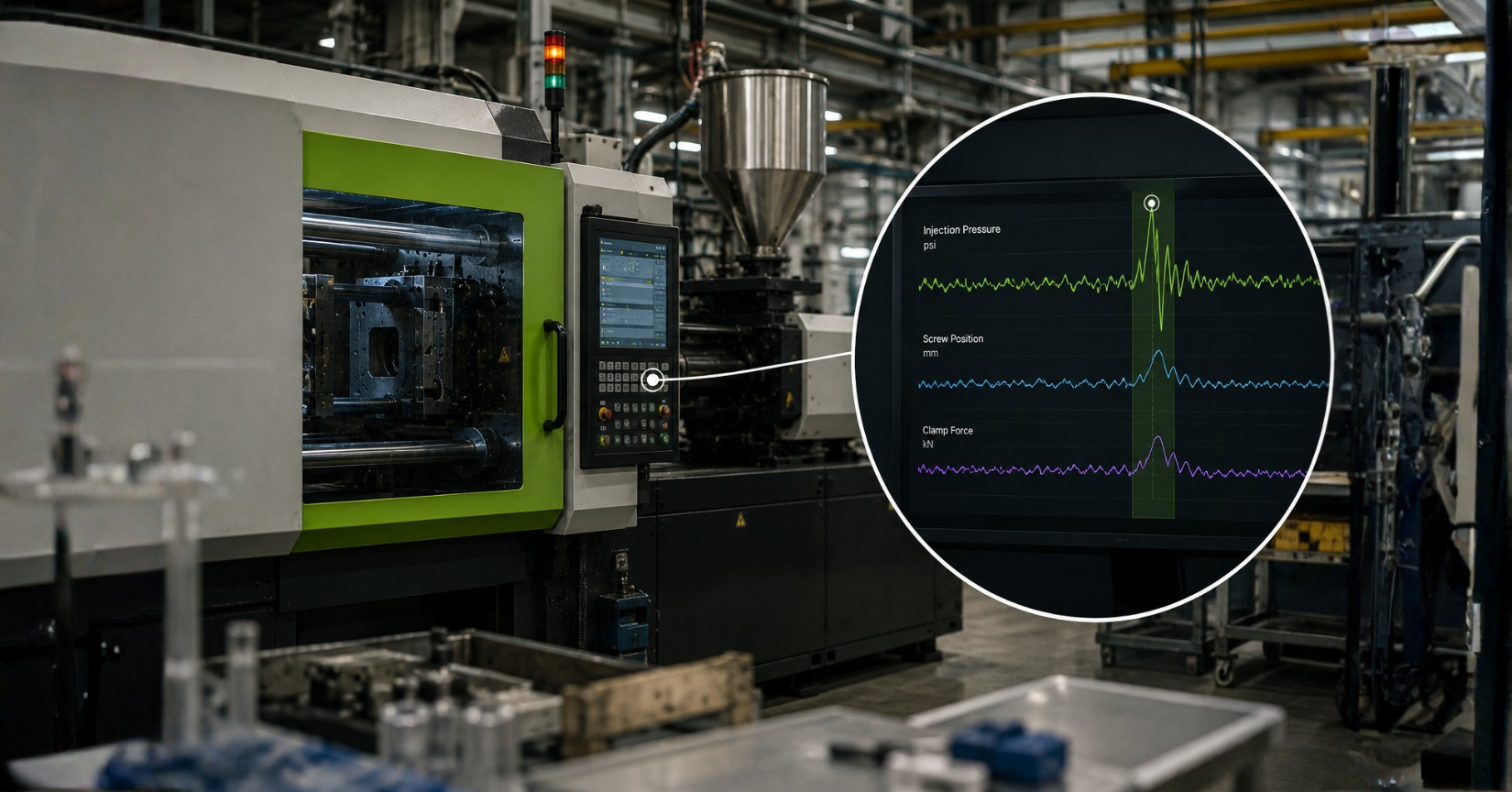
Advanced intelligence depends on a foundation most OEMs haven't built yet: the ability to capture the right data, at the right frequency, through the right infrastructure. Some machine events happen too quickly or too subtly to understand from basic status points alone, and capturing that level of detail is a data infrastructure decision, not an AI decision. Get that foundation right, and teams can start to see patterns, performance conditions, and event sequences that would otherwise be missed.
That kind of visibility can support advanced diagnostics, quality analysis, performance optimization, and future AI-enabled insights.
With the right connected machine strategy, OEMs can also begin exploring how tools like ConnectedAI can support service, diagnostics, knowledge sharing, analysis, and decision-making.
From a rollout perspective, advanced intelligence should be treated as part of the roadmap, not a shortcut around the basics. The first step is still secure connectivity, useful data, clear access rules, and adoption by the teams who need to use the system.
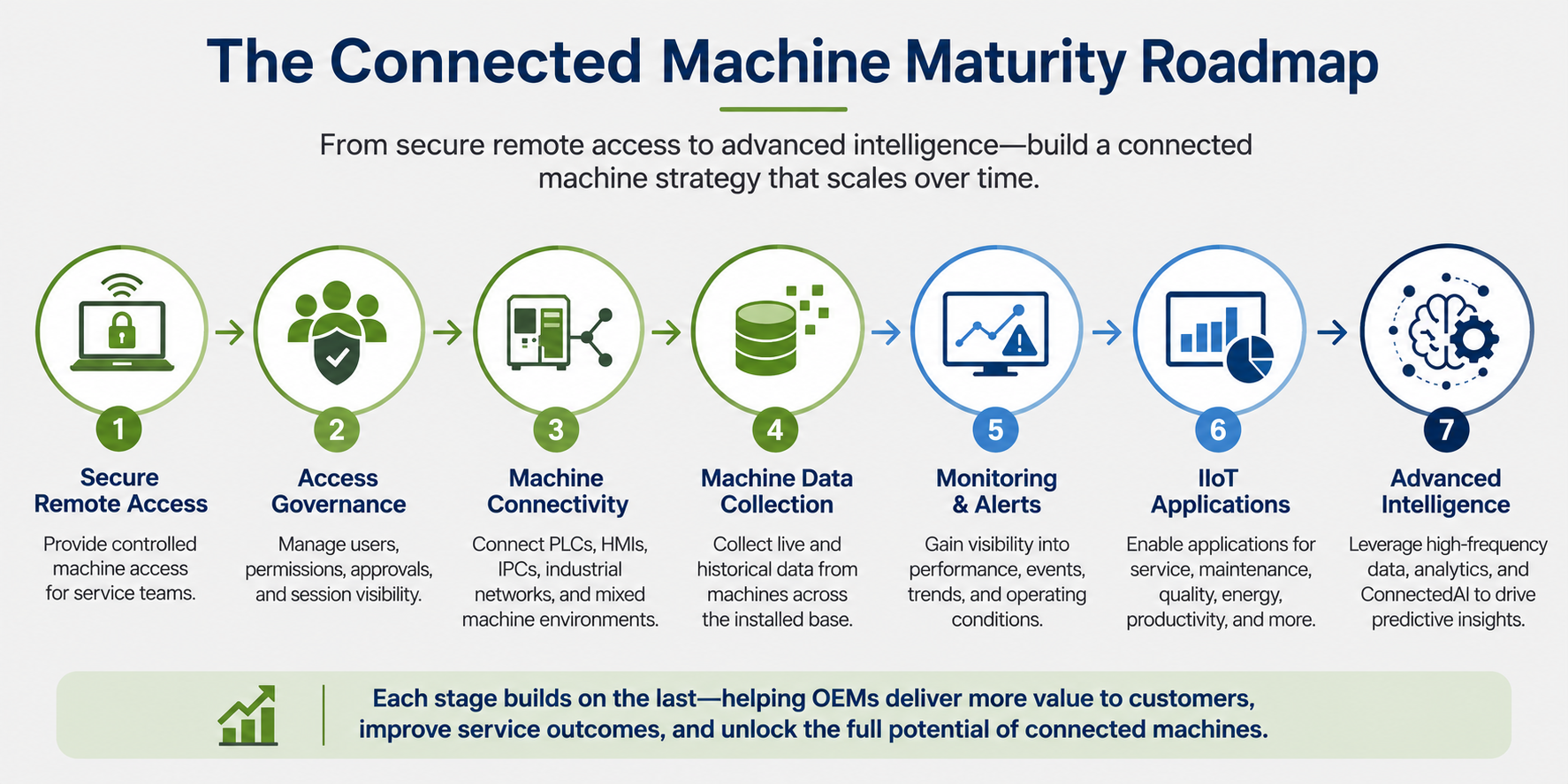
The connected machine maturity path
OEMs do not need to do everything at once. A strong program can start with secure remote access and expand deliberately over time.
How ei3 helps OEMs move beyond remote access
ei3 helps OEMs and machine builders turn remote access into a broader connected machine strategy.
With ei3, teams can start with secure industrial remote access and build toward machine connectivity, data collection, monitoring, analytics,no-code IIoT applications, and ConnectedAI.
The goal is not just to connect to a machine when something goes wrong. The goal is to create a foundation for better service, stronger customer relationships, and long-term connected machine value.
Ready to move beyond remote access?
Remote access is a strong starting point. But as connected machine programs mature, OEMs need more than a way to connect.
They need secure access governance, machine data, scalable deployment, installed-base modernization, and a path toward advanced intelligence.
If your remote access program is starting to feel limited, it may be time to ask what comes next — and to define the right next step for your machines, your customers, and your team.
ABOUT THE AUTHOR
Nicole L. Gonzalez is a Customer Success Manager at ei3 with over 15 years of experience in industrial manufacturing, customer operations, and customer success. She works closely with manufacturers to help them successfully adopt IIoT solutions, improve operational performance, and maximize the long-term value of connected machine technologies.

Nicole L. Gonzalez
Connect with me on Linkedin
Turn Connected Machines into Predictive Machines
Discover the six-step roadmap for building predictive maintenance services that reduce downtime, improve reliability, and create long-term customer value.



.svg)
.svg)
.svg)