.svg)


.png?width=20&height=20&name=Vector%20(1).png)


.svg)

This has been another defining year for industrial cybersecurity. Threat actors became faster, stealthier, and more adaptive, while manufacturers faced more attacks, higher costs, and expanding exposure across connected environments. 2025 made one thing clear: defending industrial operations now requires more than patching isolated weaknesses. It requires a strategic shift.
Year in review: the reality check
Manufacturing remained one of the most-targeted sectors
The IBM X-Force 2025 report confirms that manufacturing was the most targeted industry for the fourth consecutive year. Ransomware, extortion, and identity-driven intrusions dominated the landscape, with valid credentials obtained from phishing and vishing (voice phishing) used in nearly one-third of observed attacks.
Supply chain exposure continued to grow
ENISA found that third-party access, unvetted software components, and inconsistent security practices across suppliers remain top contributors to industrial incidents. Attackers increasingly compromise smaller partners and pivot upstream into manufacturing networks.
AI accelerated attacker capabilities
AI-enabled phishing, automated reconnaissance, and rapid exploit development made intrusions faster and harder to detect. Attackers enhanced social engineering precision and blended into normal activity more effectively.
Why manufacturing remains a prime target
- High-value intellectual property
- Critical supply chain roles that increase pressure to pay ransoms
- Rapid growth of IIoT and connected equipment
- Legacy systems not designed with cybersecurity in mind
Modern operations depend on data, connectivity, and remote access. This creates immense opportunity and equally immense risk.
What manufacturers should expect in 2026
IT and OT convergence expands attack surfaces
Deeper connectivity between IT and operational technology creates more pathways for attackers. The internal boundaries that once limited the impact of cyber incidents are fading.
AI becomes a default part of the attacker toolkit
AI-enhanced malware, phishing, and exploitation will become standard. Expect faster campaigns, more adaptive payloads, and high-precision targeting.
Enterprise systems become top-tier targets
As attackers pursue maximum disruption, platforms like ERP and MES will face more targeted operations. Compromising these systems impacts production and forces rapid response decisions.
Compliance becomes more demanding
In Europe, the EU Cyber Resilience Act and NIS2 Directive will increase requirements for secure-by-design practices, vulnerability management, and incident reporting across industrial sectors. North American companies have the benefit of the NIXT Cybersecurity Framework CSF 2.0 to use as a set of guidelines designed to improve cybersecurity across the organization, and the proposed National Cyber Incident Response Plan (NCIRP) a framework for coordinating response to significant cyber incidents.
5 actions manufacturers should take now
-
Treat OT with the same rigor as IT. Segment networks, patch where possible, and monitor continuously.
-
Apply zero trust principles to all remote and third-party access. Authenticate consistently, verify roles, and log every session.
-
Strengthen detection and response capabilities. Behavioral analytics and anomaly detection are necessary to spot intrusions early.
-
Map and monitor the full attack surface. Visibility into IT and OT connections is essential.
-
Build security into processes, not around them. Compliance should be a baseline, and security by design should guide every modernization decision.
How ei3 helps manufacturers stay secure
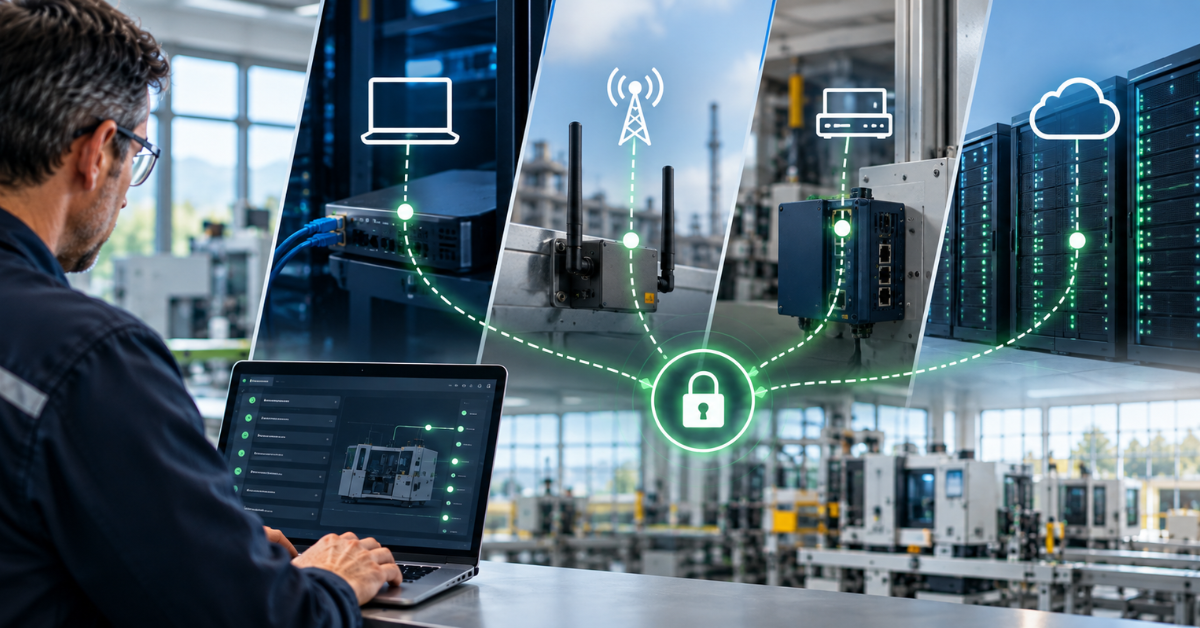
As these risks expand, manufacturers need partners who can secure connectivity without adding complexity. ei³ uses a layered, industrial-grade security architecture built for connected manufacturing environments. Secure hardware, a hardened operating system, encrypted communications, micro-segmented networks, and automated updates work together to reduce exposure across IT and OT systems.
The platform follows an “IT-approved, OT-managed” model that aligns security governance with operational needs, supported by full monitoring, session logging, and audit trails for compliance. Secure remote service provides fast, protected access for diagnostics and maintenance.
Backed by more than 25 years of experience and ISO 27001 certification, ei³ delivers continuous, end-to-end protection for critical manufacturing systems in an increasingly complex threat landscape.




.svg)
.svg)
.svg)