.svg)


.png?width=20&height=20&name=Vector%20(1).png)


.svg)

This spring's Advantech IIoT Solutions Forum in Charlotte, NC, was a valuable opportunity to talk about where industrial edge connectivity is going. For ei³, it also reinforced something we are seeing more often in the market: manufacturers and machine builders are moving beyond basic connectivity.
For years, remote access was primarily about reaching a machine when something went wrong. That model still matters, but it is no longer enough.
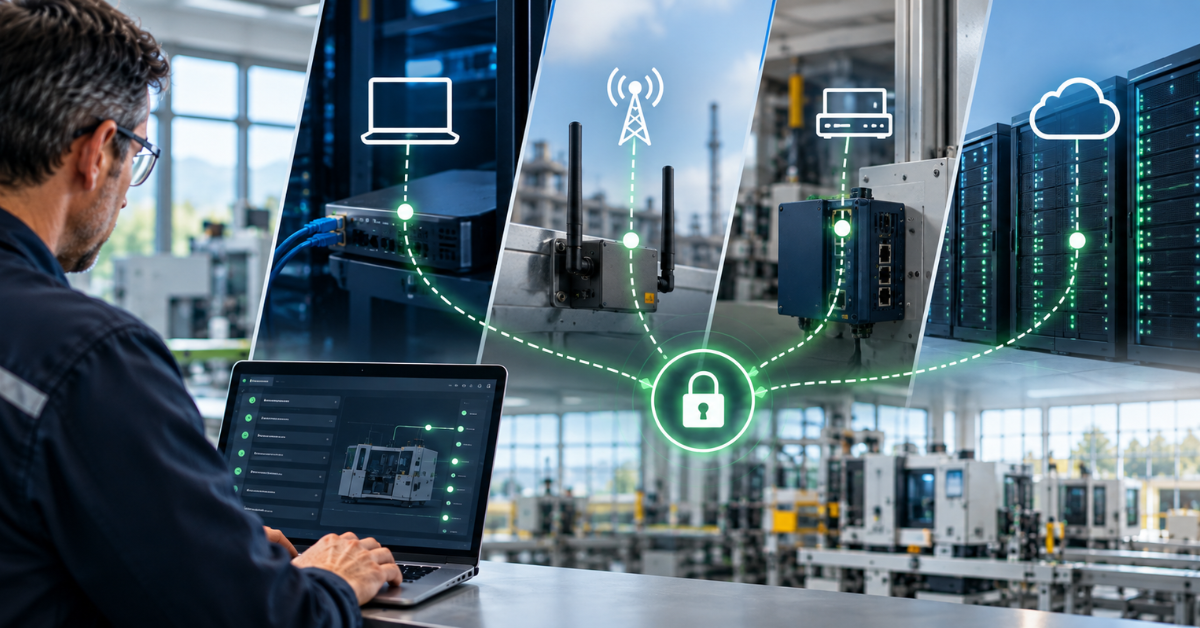
The edge is becoming part of a trusted infrastructure layer. It is where machine connectivity, local intelligence, security, access control, and cloud integration all begin to come together. That is why ei³ is working with Advantech to bring secure remote service directly into industrial edge devices.
From basic connectivity to trusted edge infrastructure
Remote access to machines is not new. The basic idea has been around for more than 20 years: create a secure connection that lets a technician reach the automation controller from anywhere in the world.
I often describe it as a very long programming cable.
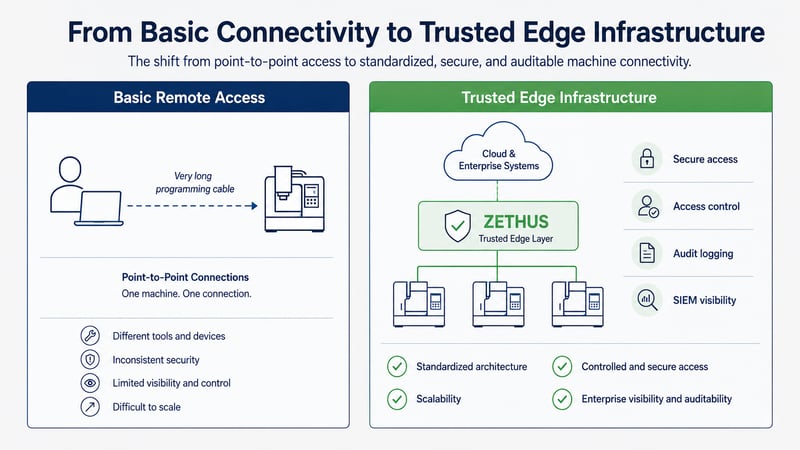
That approach created real value for machine builders and manufacturers. But over time, the number of connection methods multiplied.
At scale, that creates a problem. A global manufacturer may have thousands of machines with hundreds of different access paths. For IT and OT teams, every one of those paths becomes another doorway to monitor, govern, and secure. Some customers have told us they manage 600 different remote access methods across their global fleet. For an IT professional trying to keep bad actors out, that is not a connectivity strategy. It is a vulnerability map.
That is why the conversation is shifting from “Can we connect?” to “Can we connect in a standardized, controlled, auditable way?”
Security, sustainability, scalability, and standardization
Four themes stood out clearly at the forum:
- Security: Remote access into OT environments must be controlled, monitored, and built specifically for industrial systems. Generic IT connectivity tools were not designed for the nuanced world of programmable logic controllers, robotic controls, and motion controls. That specialized knowledge matters.
- Sustainability: Connected machines make it possible to monitor performance, reduce unnecessary service travel, support predictive maintenance, and analyze equipment lifecycle trends across a fleet. When manufacturers can benchmark machines, predict part failures, and build usage-based replenishment models, remote connectivity becomes more than a service tool. It becomes a business platform.
- Scalability: A method that works for one machine must also support product lines, global service teams, and enterprise-wide access governance. A point-to-point solution that cannot scale is not a solution. It is a starting point that creates technical debt.
- Standardization: Manufacturers need a consistent model for access, auditing, updates, and governance, including the ability to use their existing enterprise systems such as Active Directory to control who can reach what, and when.
This is where the Advantech and ei³ partnership becomes important:
✅ Advantech brings the industrial edge hardware foundation through its UNO platform.
✅ ei³ brings 25 years of secure industrial connectivity experience and the certifications enterprise and OT environments require (ISO 27001, SOC 2 Type 2, IEC 62443, and Cloud Security Alliance).
✅ ei³'s track record, combined with the Zethus edge security architecture, addresses a problem hardware alone cannot solve.
An ecosystem built around complementary partners
One of the most valuable parts of the Advantech Forum was seeing how the ecosystem is developing around the industrial edge, and specifically how each partner's capability reinforces the others:
- NVIDIA brings AI hardware and a broad set of development tools that third parties can use to build solutions around their chips.
- Edge Impulse (now part of Qualcomm) goes a step further by assembling those components into integrations that deliver real machine intelligence at the edge.
- CODESYS brings programmable logic controller capability to standard edge devices, dramatically expanding what those devices can do locally.
- Advantech provides the rugged industrial hardware platform that brings all of it together in a form factor built for factory environments.
- ei³ provides the secure connectivity and service access architecture that projects everything those edge capabilities produce out into the cloud, where it can create value that local processing alone cannot deliver.
Why hardware alone is not enough
A strong edge device is important. It needs to be rugged, reliable, and capable of supporting industrial environments. But an edge device by itself is not a trusted service platform.
To create that, hardware must work together with:
- Secure software
- Controlled access
- Encrypted communication
- Audit logging
- Remote updates
- Cloud integration
- Enterprise security visibility
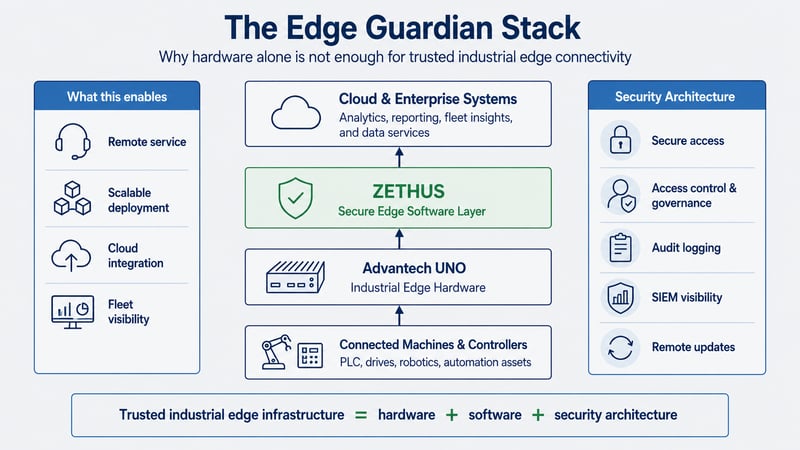
Zethus is built on exactly that model. Running on Advantech UNO hardware, Zethus creates a secure, containerized deployment, meaning the security architecture runs as a self-contained environment that is repeatable across large fleets without site-by-site configuration.
For enterprise customers, remote access activity must be auditable. That means knowing:
- Who connected and when
- Which asset was accessed
- What happened during the session
That activity needs to feed into SIEM [Security Information and Event Management] systems, the platforms security teams use to monitor events, investigate threats, and maintain audit trails. Zethus generates logs in a compatible format, giving enterprise teams visibility into remote access activity instead of leaving it outside their security model.
The edge as the first layer of protection
This is the foundation of what the industry is beginning to call Cyber-Physical Systems Protection Platforms. CPS-PP is an emerging security category, distinct from traditional IT security tools, that is specifically designed around the protection of physical systems — machines, robots, production lines — that have both a digital and a physical presence. Unlike a compromised laptop, a compromised machine can stop a production line or create a safety hazard. That is why the protection model has to start at the edge, not at the network perimeter. In this model, the edge is not just an access point. It is the first layer of a protection architecture built around the machine itself.
The edge helps establish:
- Who can connect
- What they can reach
- When access is allowed
- How activity is logged
- How machine data moves securely to the cloud
- How the equipment remains protected while still supporting service and analytics
The cloud remains essential. It enables benchmarking, predictive maintenance, fleet analysis, lifecycle insights, and new service models. But the trusted connection starts at the edge.
Every machine deserves a guardian
The larger takeaway from the forum: the edge is no longer just where connectivity begins. It is where trust, control, intelligence, and long-term machine value begin.
- For machine builders, this creates a more repeatable way to deliver remote service.
- For manufacturers, it creates more control over vendor access.
- For integrators, it creates a stronger foundation for deploying secure industrial connectivity.
- For distributors, it creates an opportunity to participate in a recurring revenue model tied to the edge.
- For Advantech, it strengthens the value of the UNO platform by pairing industrial hardware with secure service infrastructure.
That is how we think about the role of Zethus. It gives the edge device the ability to support advanced local capabilities while protecting the path between the machine, the service organization, and the cloud.
ABOUT THE AUTHOR
Spencer Cramer is the Founder and CEO of ei3 and has over 35 years of experience in manufacturing technology and automation. He founded ei3 in 1999, years before the term “IIoT” became widely used, with a vision to securely connect industrial machines. Since then, Spencer has worked closely with OEMs around the world to help shape remote service and digitalization strategies that improve efficiency, visibility, and machine performance across manufacturing environments.

Spencer Cramer
Connect with me on Linkedin
See how ei3 and Advantech deliver secure remote service at the edge
Download the brochure to see how the UNO platform and Zethus work together to deliver CPS protection across your machine fleet.



.svg)
.svg)
.svg)