.svg)


.png?width=20&height=20&name=Vector%20(1).png)


.svg)
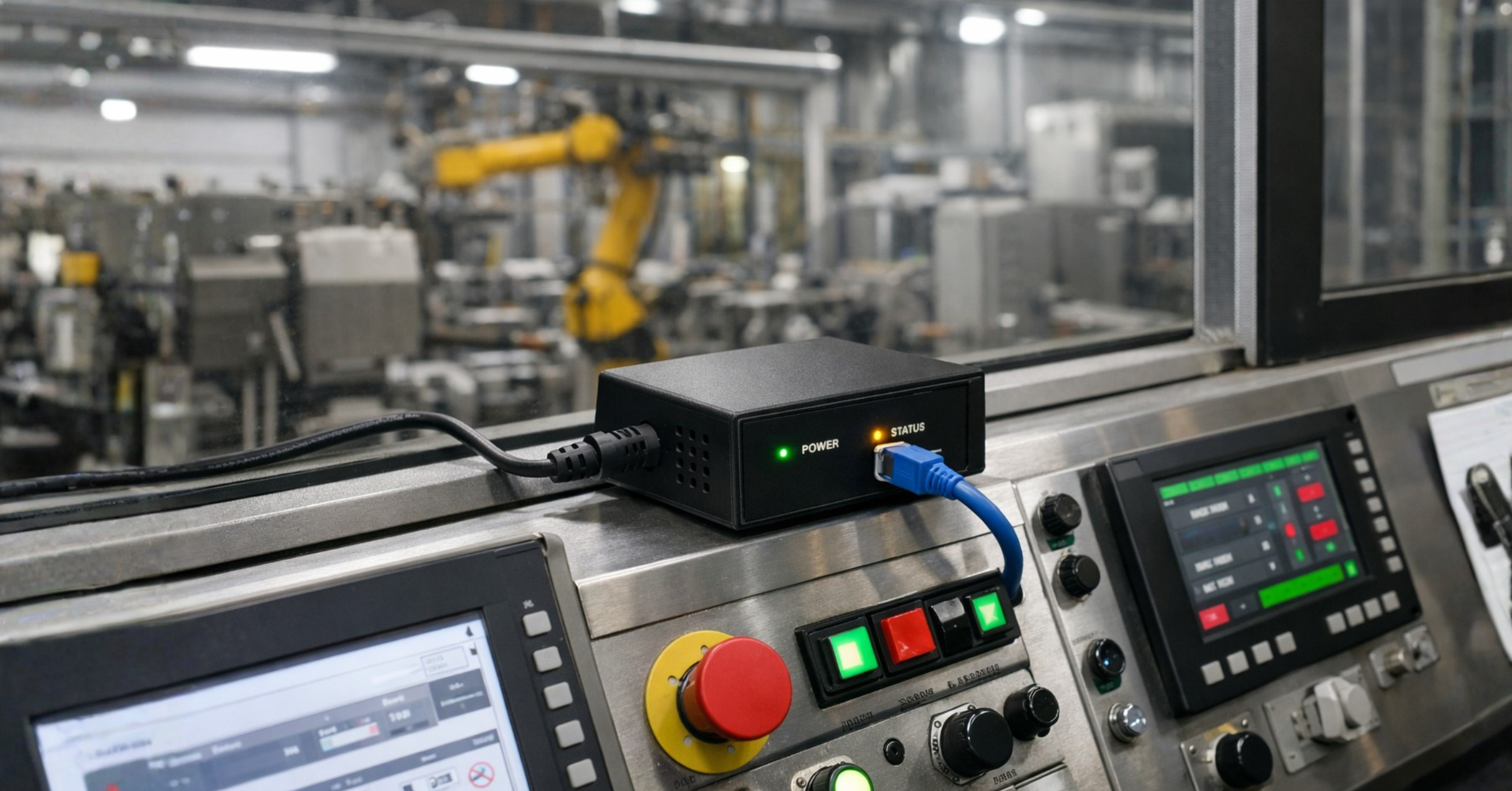

Remote access is often introduced as a shortcut. A vendor installs a small device. A tunnel is established. Service teams can log in. Problems get solved faster. On the surface, everything works. But as industrial environments scale, with more machines, more customers, and more third-party access, many organizations discover that traditional black-box remote access solutions quietly become a constraint rather than an enabler.
The issue is not encryption or connectivity. The issue is lack of transparency.
What "black-box" remote access really means
Black-box remote access solutions typically present themselves as turnkey security devices: drop-in hardware or virtual appliances, encrypted tunnels, minimal configuration required, and limited visibility into internal behavior.
From the outside, this feels appealing. Security appears "handled," and internal teams don't need to understand what's happening under the hood. That abstraction is exactly where the risk begins.
When a system becomes foundational, controlling access to real machines operating in customer environments, opacity is no longer a feature. It is a liability.
Why Black-Box Remote Access Breaks at Scale
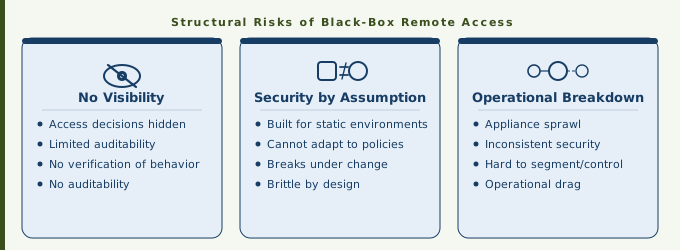
Security is not a feature you install once
Industrial security is not static. Guidance from organizations like NIST and ISA consistently emphasizes lifecycle security: identity management, credential rotation, auditability, segmentation, and continuous monitoring.
Black-box solutions often focus on establishing a secure tunnel but provide limited control over what happens inside that tunnel.
Encryption protects the path. It does not define trust.
The architectural shift: from devices to platforms
CPS Protection Platforms differ fundamentally from black-box approaches. Rather than treating remote access as a sealed appliance, they treat it as part of a broader, transparent security architecture spanning machines, users, applications, networks, and lifecycle operations.
This means access is not just established—it is defined, enforced, and continuously visible across the system.
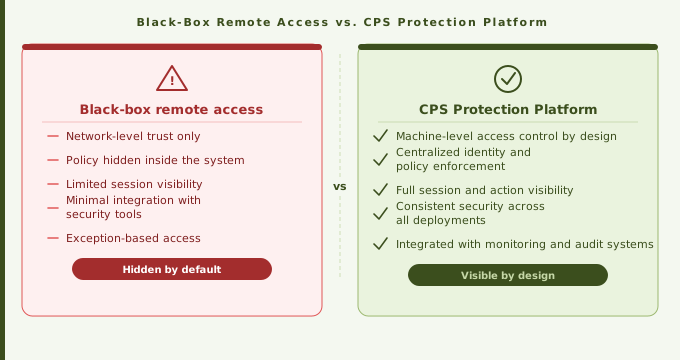 Security moves from "inside the box" to "across the system."
Why this matters before you choose how to connect
Remote access decisions shape everything that follows: how machines are onboarded, how service teams operate, how customers evaluate risk, and how scalable and repeatable the system becomes. Choosing a black-box approach early can limit architectural options later.
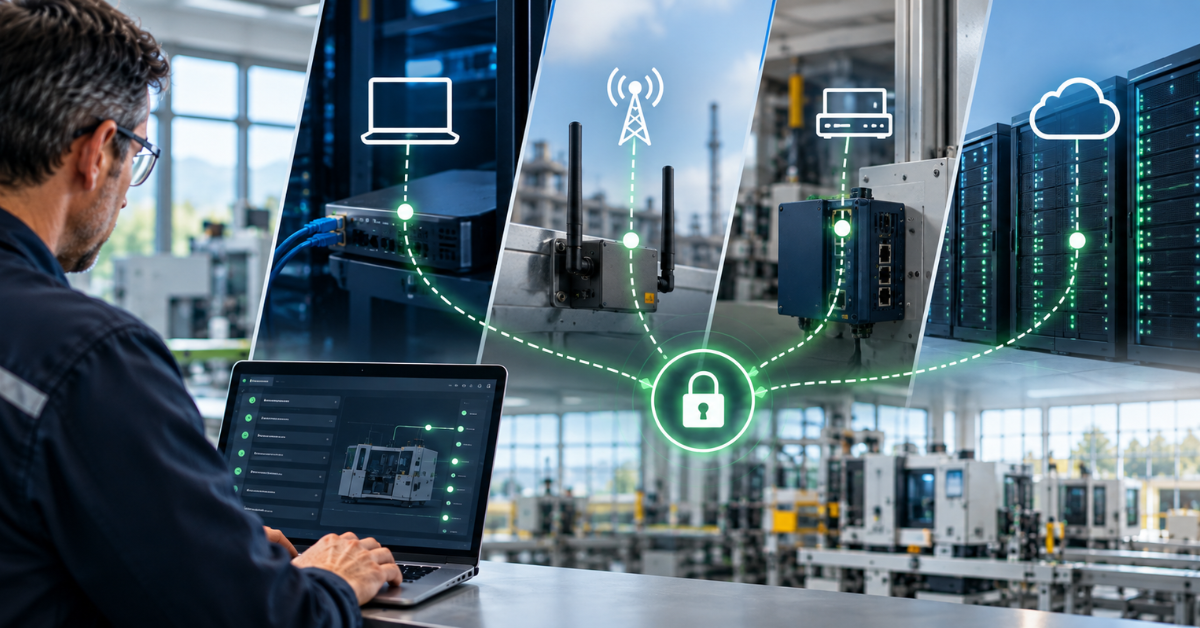
Choosing a platform approach creates flexibility, enabling hardware gateways, virtual gateways, and legacy connectivity to operate within the same security and access model rather than as isolated exceptions.
Remote access is a long-term decision
Traditional black-box remote access solutions were built for simplicity at a moment in time. Industrial systems demand durability across time.
As IIoT environments grow more complex, security can no longer depend on technology you can't see into or verify. It must be visible, adaptable, and consistently enforced across machines and customers.
Remote access is not just about getting in. It's about knowing and controlling exactly what happens once you do.
How this is implemented in practice
At ei³, this architecture is implemented through our CPS Protection Platform, which applies zero-trust principles across every layer of industrial connectivity. From secure edge gateways and segmented networks to private cloud infrastructure and IIoT applications, access is continuously verified, controlled, and visible.
This approach ensures that remote service is not treated as an isolated capability, but as part of a broader system designed to protect machines, data, and operations over time.



.svg)
.svg)
.svg)