.svg)


.png?width=20&height=20&name=Vector%20(1).png)


.svg)


With AI tools and low-code frameworks everywhere, building your own Industrial IoT solution has never felt easier. Dashboards appear quickly, connectivity feels solvable, and “vibe coding” can make early prototypes look production-ready. But when IIoT systems touch real machines, real customers, and real operational risk, the true cost of DIY rarely shows up at launch. It shows up later, quietly, and often expensively.
Why DIY IIoT is so tempting
For many manufacturers and OEMs, building in-house feels logical:
- You know your machines and processes best
- You want control over data and IP
- Commercial platforms can feel heavy or costly
- AI-assisted development accelerates experimentation
Early pilots often succeed. Data flows. Stakeholders are impressed. The challenge begins when those pilots become production systems.
AI “Vibe Coding” meets industrial reality
AI-assisted development is a real productivity boost for internal tools and low-risk applications. Industrial IoT is different.
IIoT systems must be secure by design, behave predictably under failure, and remain maintainable for years. Fast-generated code often struggles with long-term security, credential management, deterministic behavior, and operational resilience.
In manufacturing environments, “mostly works” is not acceptable.
Where DIY costs start to compound
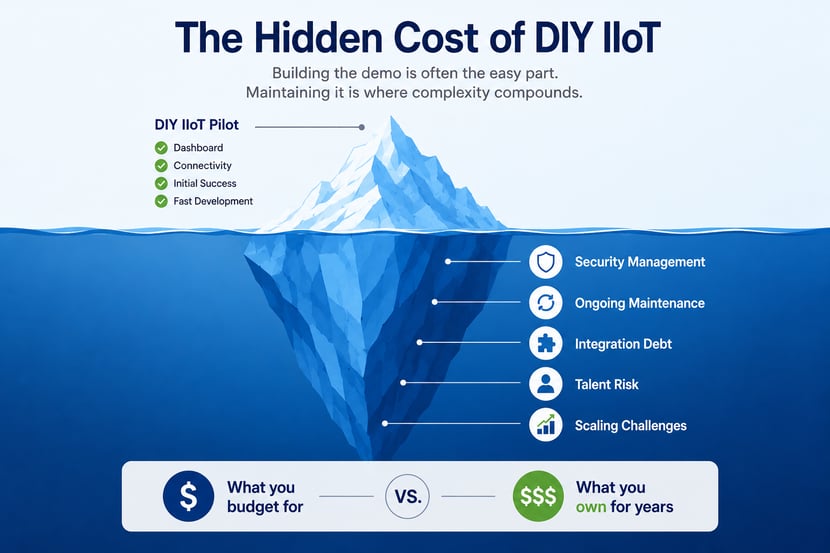
Early pilots often succeed. The challenge is that many of the largest costs associated with DIY IIoT do not appear during development. They emerge over time as systems scale, requirements evolve, and operational responsibility grows.
⚠️ Security is never done.
According to the National Institute of Standards and Technology (NIST), industrial systems require continuous security management across their full lifecycle, not one-time hardening.
⚠️ Maintenance never plateaus.
Custom IIoT solutions demand ongoing updates to operating systems, dependencies, cloud infrastructure, and device compatibility.
⚠️ Integration debt grows silently.
Ad-hoc protocols, custom data models, and one-off customer requirements accumulate over time, making scaling slower and riskier.
⚠️ Talent risk concentrates quickly.
In-house platforms often depend on a few key engineers. When they leave, so does critical system knowledge.
DIY vs Platform: A practical comparison
| Area | DIY IIoT | Industrial IIoT Platform |
| Time to first demo | ✅ Fast | ✅ Fast |
| Time to secure, scalable deployment | ⚠️ Long | ✅ Shorter |
| Security ownership | ⚠️ Internal, ongoing | ✅ Built-in, continuously maintained |
| Maintenance burden | ⚠️ High and permanent | ✅ Largely abstracted |
| Scalability | ⚠️ Increases complexity | ✅ Designed to scale |
| Talent dependency | ⚠️ High | ✅ Lower |
| Focus of internal teams | ⚠️ Infrastructure | ✅ Applications and service value |
It’s not about control. It’s about focus.
The real question is not whether you can build IIoT internally. It’s whether that is the best use of your time and talent.
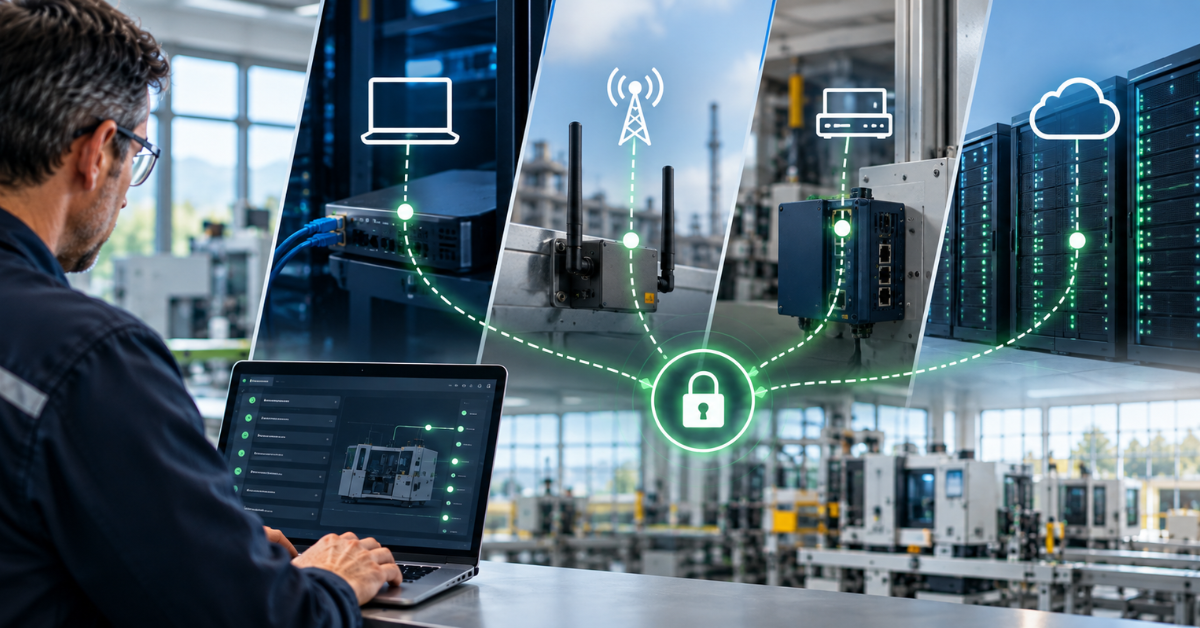
Modern IIoT platforms handle the non-differentiating foundation: secure connectivity, device management, and lifecycle operations. That frees internal teams to focus on analytics, service models, and customer outcomes.
The ei³ platform is designed to support secure industrial connectivity across a wide range of machines and deployment models without requiring custom infrastructure for every use case.
A better question to ask
Instead of asking, “Can we build this ourselves?” ask:
"Which parts of IIoT truly differentiate us, and which parts quietly drain time, talent, and attention over the long term?"
DIY IIoT can work. But understanding its full cost is what turns it from a shortcut into a strategic decision.




.svg)
.svg)
.svg)