.svg)


.png?width=20&height=20&name=Vector%20(1).png)


.svg)
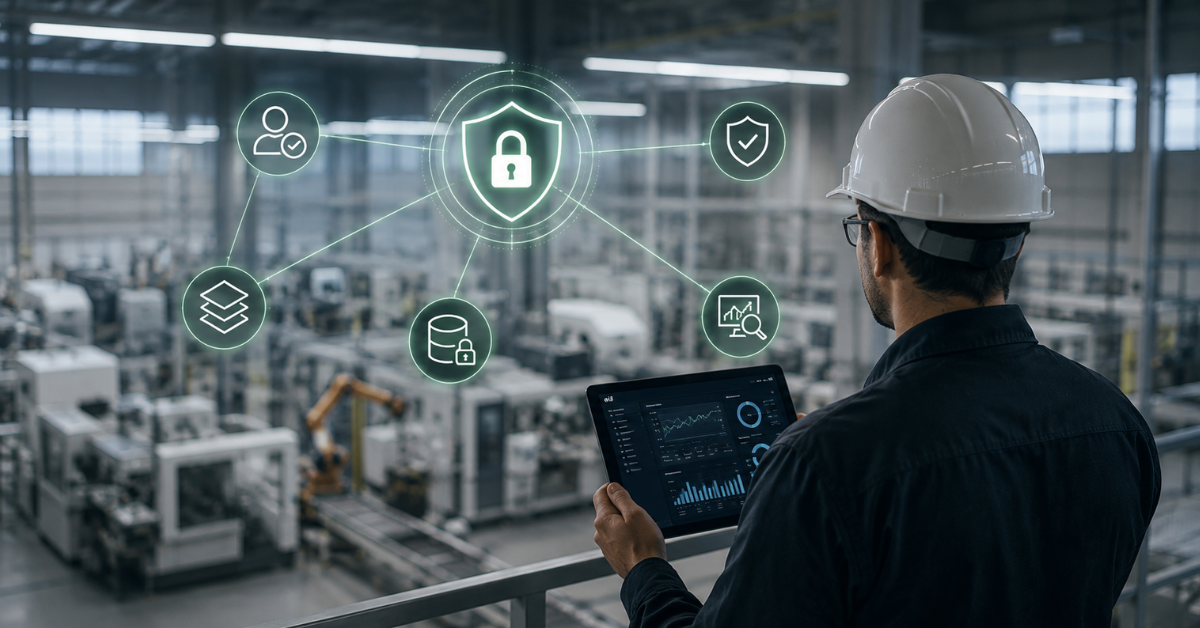

Technology alone doesn't create a secure industrial environment. Firewalls, encryption, authentication, and access controls are only as effective as the principles guiding how and where they're applied.
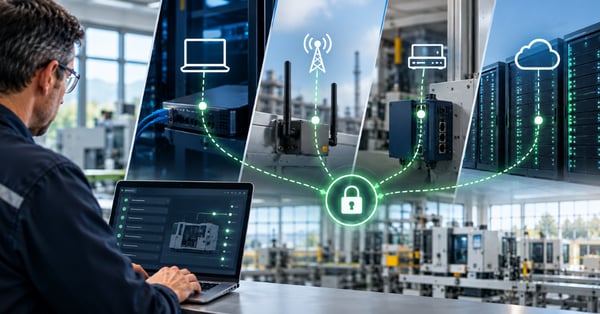
For connected factories, security has to extend across the entire industrial environment—from machines and edge devices to networks, cloud infrastructure, applications, users, and operational data.
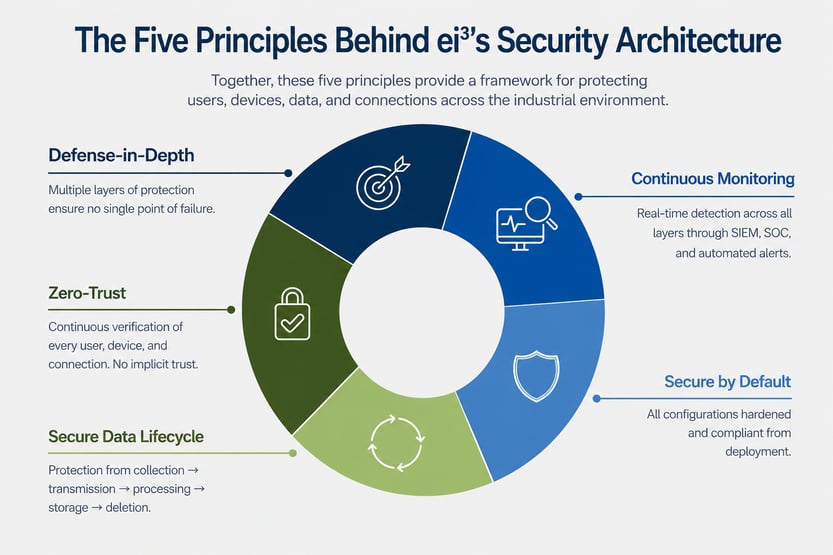
At ei³, five security principles guide the architecture used to protect connected industrial operations:
- Defense-in-Depth: use overlapping safeguards instead of relying on any single security control.
- Zero Trust: authenticate and authorize users, devices, and connections rather than assuming they are trustworthy.
- Secure Data Lifecycle: protect industrial data from collection through transmission, processing, storage, and retirement.
- Continuous Monitoring: maintain visibility and detection capabilities throughout the life of the system.
- Secure by Default: build protection into the architecture from deployment rather than depending on later hardening.
Together, these principles help ensure cybersecurity is not treated as an add-on. Protection is built into every layer, while monitoring, patching, access controls, and governance help the security posture continue evolving over time.
For a deeper look at how these principles are implemented across industrial systems, explore ei³ Platform Security or download the complete ei³ Security Architecture for Industrial Operations guide below.
1. Defense-in-Depth: No Single Point of Failure
No individual security control should be expected to protect an entire industrial environment on its own.
Defense-in-Depth uses multiple, overlapping safeguards so that if one control is challenged or fails, others remain in place.
At ei³, this approach includes several categories of protection working together:
- Governance controls such as policies, audits, and product development aligned with standards including ISO 27001, SOC 2 Type II, and IEC 62443.
- Operational controls including logging, monitoring, automated alerting, and incident detection and response.
- Data protection controls such as encryption, tokenization, and data loss prevention.
- Identity and access controls including centralized identity management, multi-factor authentication, role-based access control, and least privilege.
- Network security controls such as firewalls, VPNs, segmentation, and intrusion prevention.
The goal is to avoid creating a single point of failure. By integrating multiple controls into one architecture, security does not depend entirely on one firewall, gateway, credential, or connection.
This becomes especially important for industrial remote access, where protecting the connection itself is only part of the problem. Access also needs to be controlled, segmented, monitored, and auditable.
Read more: Top Secure Remote Access Options for OEM Field Service Teams
2. Zero-Trust: No Implicit Trust
Perimeter security alone isn't enough for distributed industrial environments.
Zero Trust removes the assumption that a user, device, or service should be trusted simply because of where it is connecting from.
Instead, connections are authenticated and authorized, while credentials and active sessions can be reassessed as context and risk change. Micro-segmentation adds another layer of protection by limiting how far a compromise can spread and helping prevent unauthorized lateral movement between systems.
Zero Trust also assumes that breaches are possible. Detection, containment, and recovery therefore become part of the security model from the beginning rather than something considered only after an incident.
For industrial remote service, this means access can be controlled around a much more useful question:
Who should be able to access which machine, under what permissions, and for how long?
That allows service teams to reach the equipment they are responsible for without assuming that broader network access should come with it.
Read more: Why “Zero Trust” Actually Matters in Industrial Remote Service
3. Secure Data Lifecycle: Protection from Creation to Retirement
Industrial data moves through several stages during its life. It is collected, transmitted, processed, stored, accessed, and eventually retired.
Each stage needs protection.
At collection, data originates from authenticated, signed edge devices. During transmission, encrypted tunnels and TLS help prevent interception or tampering. During processing, access to compute and storage resources is governed through role-based access control and audit logging.
When data reaches the end of its useful life, retention and disposal policies help ensure it is handled according to regulatory and customer requirements.
Treating security as a full lifecycle creates a chain of custody that protects sensitive operational and business data from creation through retirement. That becomes increasingly important as machine data is used beyond basic monitoring for analytics, enterprise integration, predictive applications, and AI.
For more on the role of secure machine connectivity and data collection, read Before You Can Use Machine Data, You Have to Reach It.
4. Continuous Monitoring: Security That Doesn't End at Deployment
Threats don't stay the same after a system goes live, so a security posture that stops evolving at deployment is really just a snapshot of the day it was installed.
Continuous monitoring helps security teams maintain visibility as systems, users, connections, and threats change over time.
Real-time detection across edge devices, managed networks, private cloud infrastructure, and IIoT applications helps identify anomalies across every layer.
Logs from each layer feed into a centralized Security Information and Event Management (SIEM) system. Integration with existing enterprise SIEM platforms also allows security teams to extend familiar correlation rules, analytics, and threat-detection capabilities into their industrial environments.
The result is a security posture designed to continue evolving throughout the life of the system rather than one built only around the conditions that existed at deployment.
This is also one reason industrial cybersecurity architecture matters beyond initial installation. Connected machines may remain in service for years, while users, software, vulnerabilities, and security requirements continue to change around them.
Explore: ei³ Trust Center
5. Secure by Default: Protected from Deployment
Security shouldn't depend on additional hardening steps after a system has already been installed.
A Secure by Default approach establishes a protected baseline from the beginning.
Configurations, interfaces, and APIs are hardened and aligned with baseline security standards from deployment, reducing the need for post-installation hardening or manual security configuration.
Starting from a secure baseline also helps maintain consistency across devices and systems as industrial deployments grow.
For machine builders in particular, that consistency matters as connected products are deployed across more customers, facilities, and regions. Security becomes much easier to manage when the starting configuration is controlled rather than recreated machine by machine.
Secure-by-default product design is also increasingly relevant as machine builders prepare for requirements such as the EU Cyber Resilience Act.
Read more: Preparing for the Cyber Resilience Act: A Guide for Machine Builders
Principles, Not Just Products
Defense-in-Depth, Zero Trust, a Secure Data Lifecycle, Continuous Monitoring, and Secure by Default each address a different part of the industrial cybersecurity challenge.
Together, they create an architecture in which users, devices, data, networks, and connections are protected across multiple layers rather than relying on one technology or one perimeter.
That is the larger point behind these five principles.
Industrial cybersecurity isn't defined by having a firewall, VPN, encrypted connection, or secure gateway. It comes from designing protection into the architecture from the beginning—and maintaining that protection as the connected environment changes.
At ei³, these principles are applied across edge devices, managed networks, private cloud infrastructure, and IIoT applications.
Want to see how the five principles are applied in practice?
Download the ei³ Security Architecture for Industrial Operations guide for a closer look at the controls protecting connected industrial operations from the factory floor through the cloud.
You can also:
- Explore ei³ Platform Security for an overview of platform security capabilities.
- Visit the ei³ Trust Center for certifications, security documentation, and due-diligence information.
- Read IIoT Cybersecurity: Protecting Connected Machines for a broader look at industrial cybersecurity.
ABOUT THE AUTHOR
Adam Griffen is the Cybersecurity & Compliance Manager at ei3, bringing over 10 years of experience across automation, product management, and industrial digital security. He has worked in roles ranging from operator and technician to engineer and product manager, giving him a practical understanding of the cybersecurity, compliance, and operational challenges manufacturers face. Adam also serves as Chair of OMAC’s Digital Transformation Workgroup, contributing to initiatives involving PackML and OPC UA standards.



.svg)
.svg)
.svg)