.svg)


.png?width=20&height=20&name=Vector%20(1).png)


.svg)
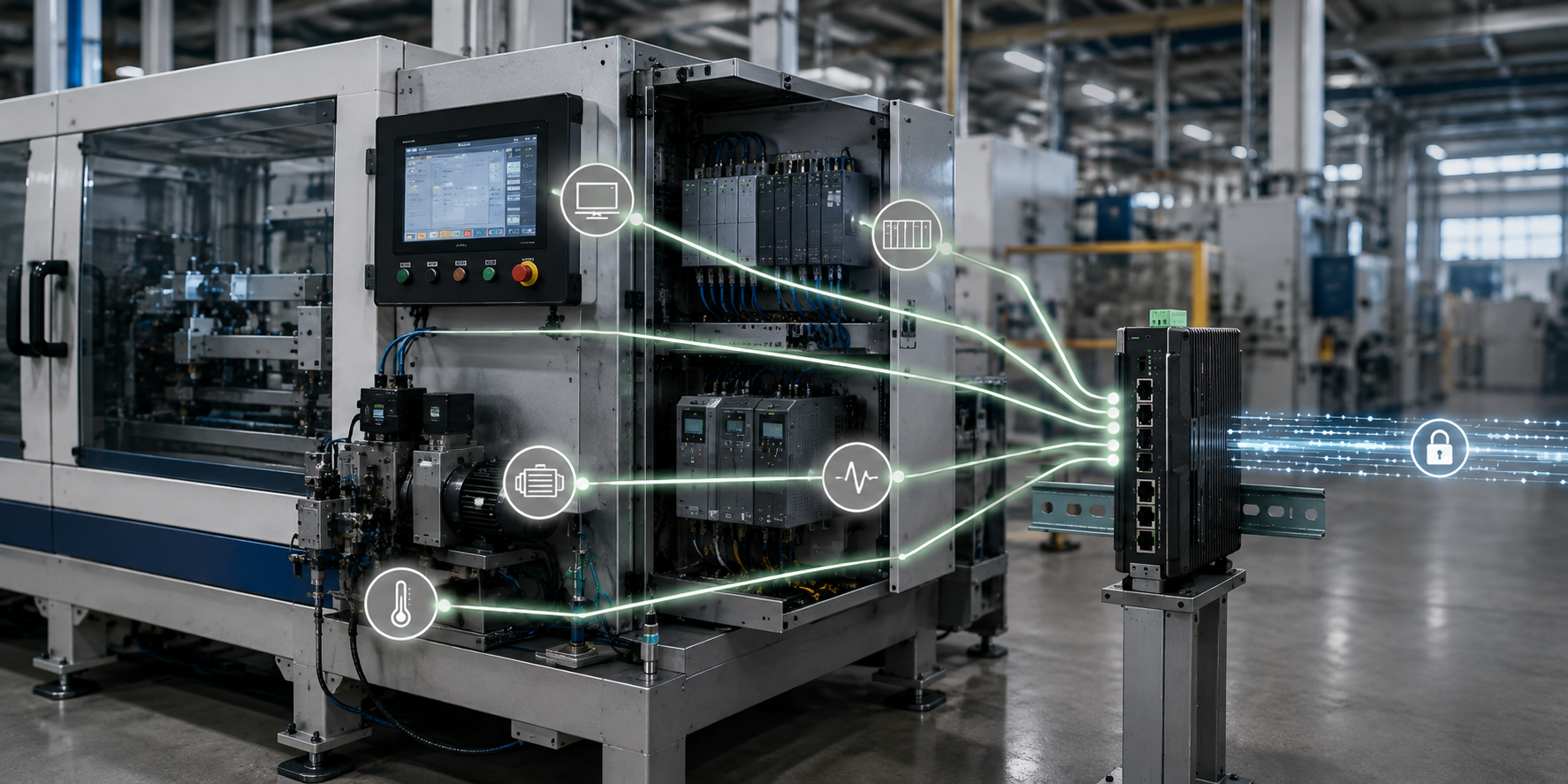

Machine data is becoming the foundation for everything from real-time monitoring and faster service to predictive maintenance and industrial AI. But the value is not in simply having more data. It comes from being able to securely collect the right information from machines, organize it consistently, and put it to work across an installed fleet.
That can be harder than it sounds. Industrial equipment rarely follows one standard architecture. Different machine generations, control platforms, communication protocols, and customer configurations all affect where useful data lives and how it can be accessed. The first challenge in any machine-data strategy is therefore not building the dashboard or choosing the AI model. It is reaching the data reliably.
Want to see how your equipment may connect? Search the ei³ Machine Compatibility Checker by brand, model, or protocol to explore standard data collectors already available for your equipment.
From there, the opportunity gets much bigger. Once machine data can be collected consistently, it becomes a shared foundation for monitoring, service, production, quality, maintenance, analytics, integrations, and AI.
Machine data lives throughout the machine
The information needed to understand machine performance rarely exists in only one place.
A PLC may contain production counts, machine states, cycle times, alarms, temperatures, pressures, speeds, and recipes. Additional information may be available from:
- HMIs and industrial PCs
- Smart I/O
- Variable-frequency drives
- Servos and motion systems
- Pneumatic and hydraulic systems
- Inspection and quality equipment
- Energy meters
- Sensors
- Databases and other connected systems
The challenge is not usually whether the data exists. It is whether it can be accessed consistently across equipment built at different times, by different suppliers, and with different control architectures.
Universal data collection is possible when the right collection methods have already been developed for that variety of industrial equipment. Over more than two decades of connecting machines, ei³ has built a library of standard data collectors using widely adopted industrial protocols, platform-specific interfaces, and specialized methods for older systems.
This allows relevant data to be gathered from across the machine without requiring every asset to use the same controller, protocol, or architecture. The result is a consistent foundation for monitoring, operational applications, integrations, analytics, and AI.
Which machine data should you collect? Start with the question, not every available tag
A successful project does not begin by collecting every available data point. It begins by identifying the operational question the team wants to answer.
For example:
- Why does this machine repeatedly stop?
- Are cycle times changing?
- Which conditions occur before an alarm?
- Is a critical pressure or temperature moving outside its normal range?
- How does the performance of one machine compare with similar equipment?
- Is the machine operating as expected at the customer site?
Once the question is defined, teams can identify the machine states, alarms, counts, measurements, settings, or events required to answer it. A smaller set of relevant, reliable data is generally more useful than thousands of tags collected without a clear purpose.
The next question is whether those signals can be securely collected from the existing machine.
A faster way to understand machine compatibility
Before starting a machine-data project, it helps to know what is already possible with the equipment in front of you.
The ei³ Machine Compatibility Checker lets you search standard data collectors by brand, model, or protocol to see whether a proven collection method already exists for your equipment. Results show how the connection is typically made, whether through a standard industrial protocol or a platform-specific interface.
The checker covers many widely deployed industrial controls and systems, including equipment using technologies such as OPC UA, Modbus TCP, EtherNet/IP, Siemens S7, Beckhoff TwinCAT, Mitsubishi MELSEC, and Allen-Bradley RSLinx.
It is meant to be a practical starting point, not a complete engineering assessment. If your exact controller or machine is not listed, it may still be compatible through another supported protocol or interface.
Mixed machine fleets require flexible data collection
Can data be collected from a mixed machine fleet? Yes. Mixed equipment is the norm in most industrial environments.
A facility may have newer machines using OPC UA beside older equipment with proprietary controls. An OEM may use different controller brands across product lines or change controls during the lifetime of a machine model. Customer specifications can also result in different configurations from one installation to another.
ei³ combines several collection approaches to accommodate these differences:
- Standard protocols for modern industrial equipment
- Brand-specific interfaces optimized for major automation platforms
- Specialized collectors for legacy machines and controls
- Connections to additional sources, including compatible databases, industrial PCs, and web-based data sources
This allows information from different brands and equipment generations to be brought into a consistent environment rather than requiring a separate data solution for every machine.
Standardization turns connectivity into a scalable strategy
Connecting one machine is relatively straightforward. The greater challenge is creating an approach that can be repeated across machine models, control platforms, customer sites, and equipment generations.
Without standardization, each connected machine can become a separate engineering project. Different hardware, software, security methods, and data structures create more systems to support and make it harder to expand digital services across an installed fleet.
For OEMs, connectivity and data collection therefore become more than technical implementation decisions. They influence how quickly new services can be deployed, how consistently machines can be supported, and whether data-driven capabilities can scale across the business.
As explored in Why Standardized Connectivity Is Becoming a Strategic Decision for OEMs, what once functioned like a long-distance programming cable is increasingly becoming the foundation for remote service, machine data, applications, and long-term customer value.
Universal Data Collection extends that standardized approach to the information inside the machine, helping teams work with data consistently even when the underlying controls differ.
Collecting data should not mean redesigning the machine
A key question that we often get when starting machine programs with OEMs or manufacturers is if they will have have to change the PLC program to collect data. In many cases, the answer is no. ei³ uses non-intrusive collection methods that read data from the existing controller without requiring changes to its PLC logic or operating program. This helps avoid unnecessary controls-engineering work, production interruptions, and risk to proven machine logic.
That distinction is especially important when connecting equipment already operating at customer sites or machines with established and validated control programs.
The goal is to use the data already available within the machine and not redesign the machine simply to access it.
Security has to start at the data source
Machine data should not be made available by exposing controllers directly to the internet or creating unmanaged pathways into the machine network.
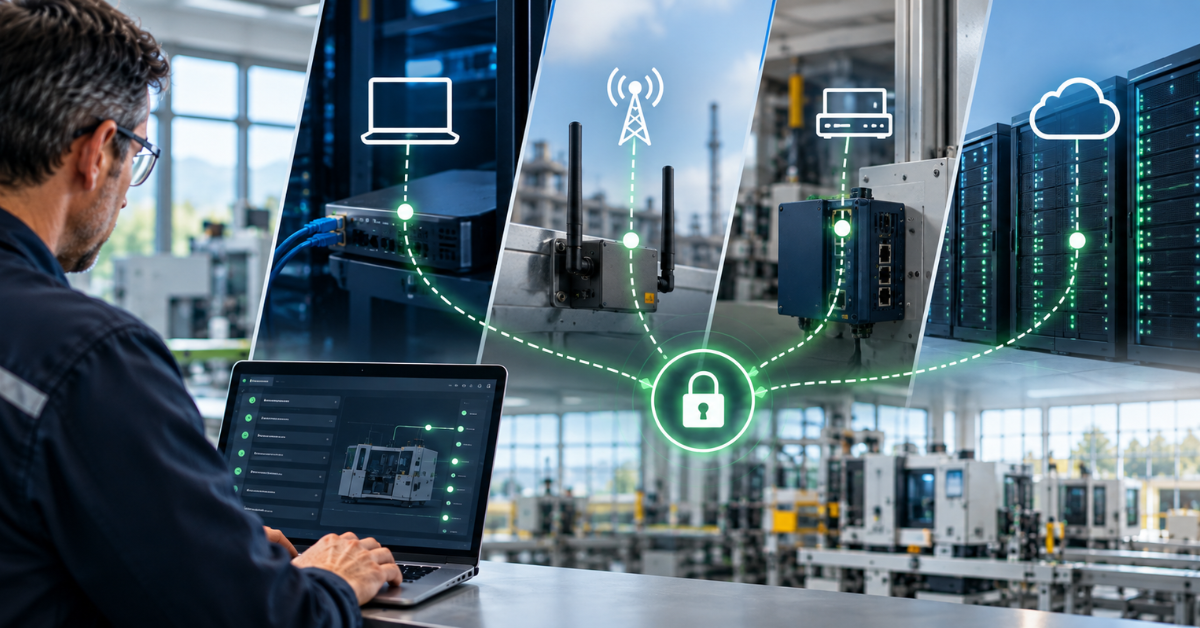
Collection should use secure communications, controlled access, and clear separation between the operational environment and the applications or systems using the information.
ei³ Universal Data Collection supports real-time collection using encrypted transmission and comprehensive audit trails. It can also support cloud and edge collection approaches depending on the machine, data frequency, local-processing needs, and available connectivity.
Security needs to be part of the data architecture from the beginning. It is not something to be added after machines and data sources have already been connected.
Collection is the foundation, not the outcome
What can you do after collecting machine data? Data collection creates the foundation. Its value comes from making the information visible and actionable.
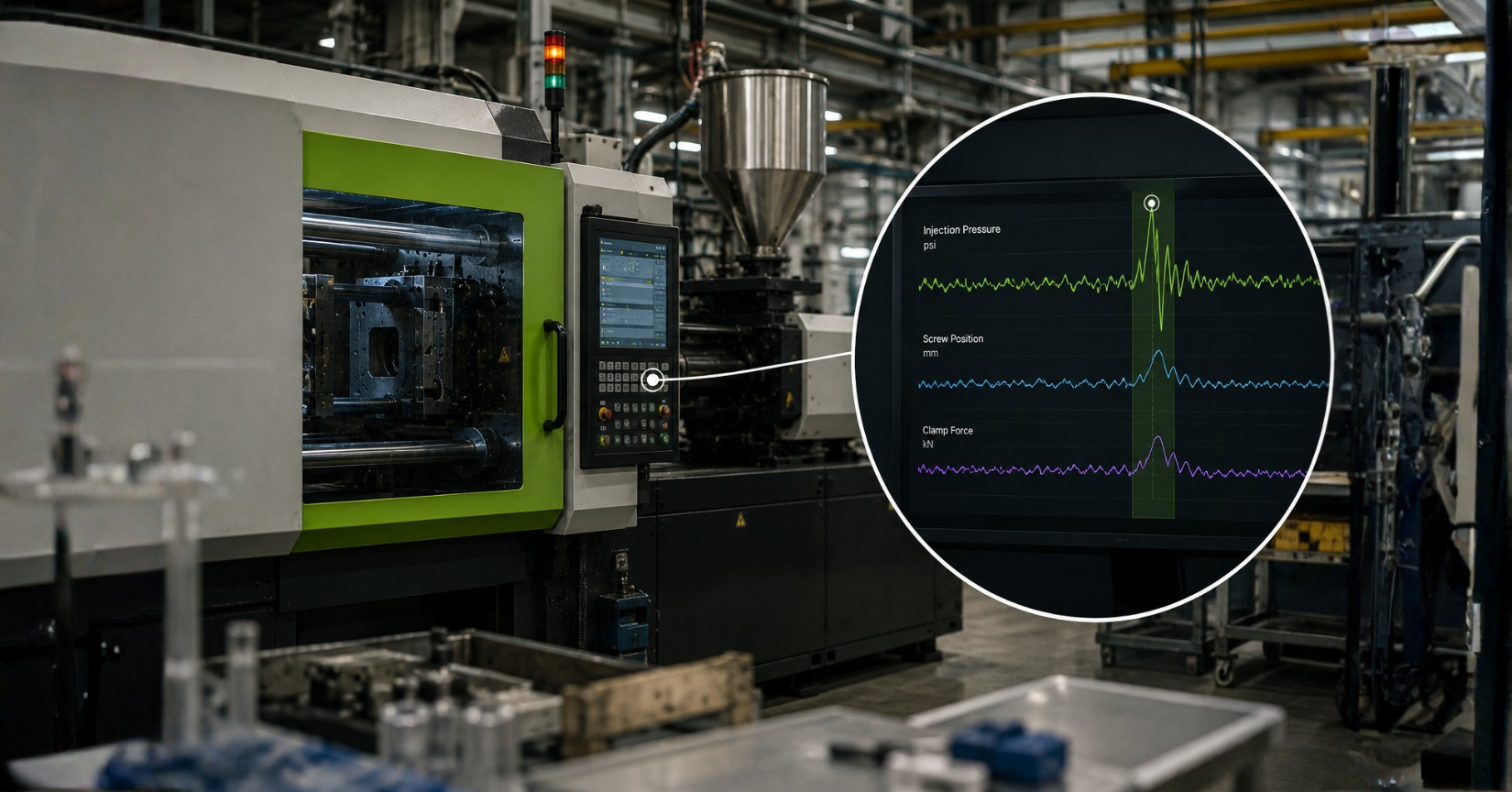
For many organizations, ei³ MONITOR provides a practical first use of that data. Teams can use it to review live and historical machine information, analyze trends, compare performance, and establish alerts around the conditions that matter most.
The same data foundation can support additional applications for:
- Remote service
- Production performance
- Downtime and OEE
- Quality
- Preventive maintenance
- Machine lifecycle management
- Recipes and process settings
- Energy and resource consumption
- Enterprise integrations
- ConnectedAI
Organizations do not need to begin with every machine or application. They can establish value with an initial monitoring use case and expand into additional capabilities over time.
Industrial AI needs machine context
Why is machine data important for industrial AI? Industrial AI depends on more than simply having a large volume of data.
The information also needs context:
- Which machine generated it?
- What was the machine doing at the time?
- Which product or recipe was running?
- What events and alarms occurred?
- How does current behavior compare with historical performance?
- What service, maintenance, or quality activity is relevant?
Without that context, an AI system may recognize a numerical change without understanding what it means operationally.
Consistent machine-data collection is therefore not only a prerequisite for dashboards and monitoring. It also helps create the structured, machine-aware foundation required for anomaly detection, predictive models, and AI Advisors that can deliver relevant industrial insights.
Where should a machine-data project begin?
Start small, then build on the data foundation.
A practical machine-data project can start with five steps:
- Identify a machine, fleet, or operational challenge.
- Determine which controls and systems contain the relevant data.
- Confirm how the equipment can be securely connected.
- Begin collecting and monitoring the information that matters.
- Expand into additional applications, analytics, and AI over time.
The first step does not need to be a large digital-transformation project. Begin with a specific machine or operational need, then determine how the required data can be securely collected.
Search the ei³ Machine Compatibility Checker to explore the standard collectors available for your equipment.
About the author
The ei3 Team includes experts across industrial automation, cybersecurity, remote service, connectivity, and IIoT technologies. Combining experience across technical, operational, and customer-facing roles, the team shares insights and practical strategies that help OEMs and manufacturers improve machine performance, security, and operational visibility.





.svg)
.svg)
.svg)