
Some of the biggest names in industrial equipment run connected service programs that carry their brand, not their technology provider's. That's not an accident. It's a strategic decision about who owns the customer relationship, how services are delivered, and where future aftermarket revenue comes from.
For original equipment manufacturers (OEMs), launching a connected service platform generally means choosing between three approaches: building software internally, reselling another company's solution, or white labeling an established platform.
Each has advantages. But for machine builders that want to deliver digital services under their own brand without becoming software companies, white labeling offers a compelling alternative.
What is a white-label connected service platform?
A white-label connected service platform is software developed and maintained by a technology provider but delivered to customers under an OEM's own brand. The OEM manages its service offering and customer relationships, while the technology partner provides the underlying infrastructure, applications, security, and ongoing software development.
Think of it like a private-label product on a store shelf. Another company makes the product, but the brand on the package is the one the customer recognizes and trusts. In industrial environments, though, the implications go well beyond putting a logo on a screen.
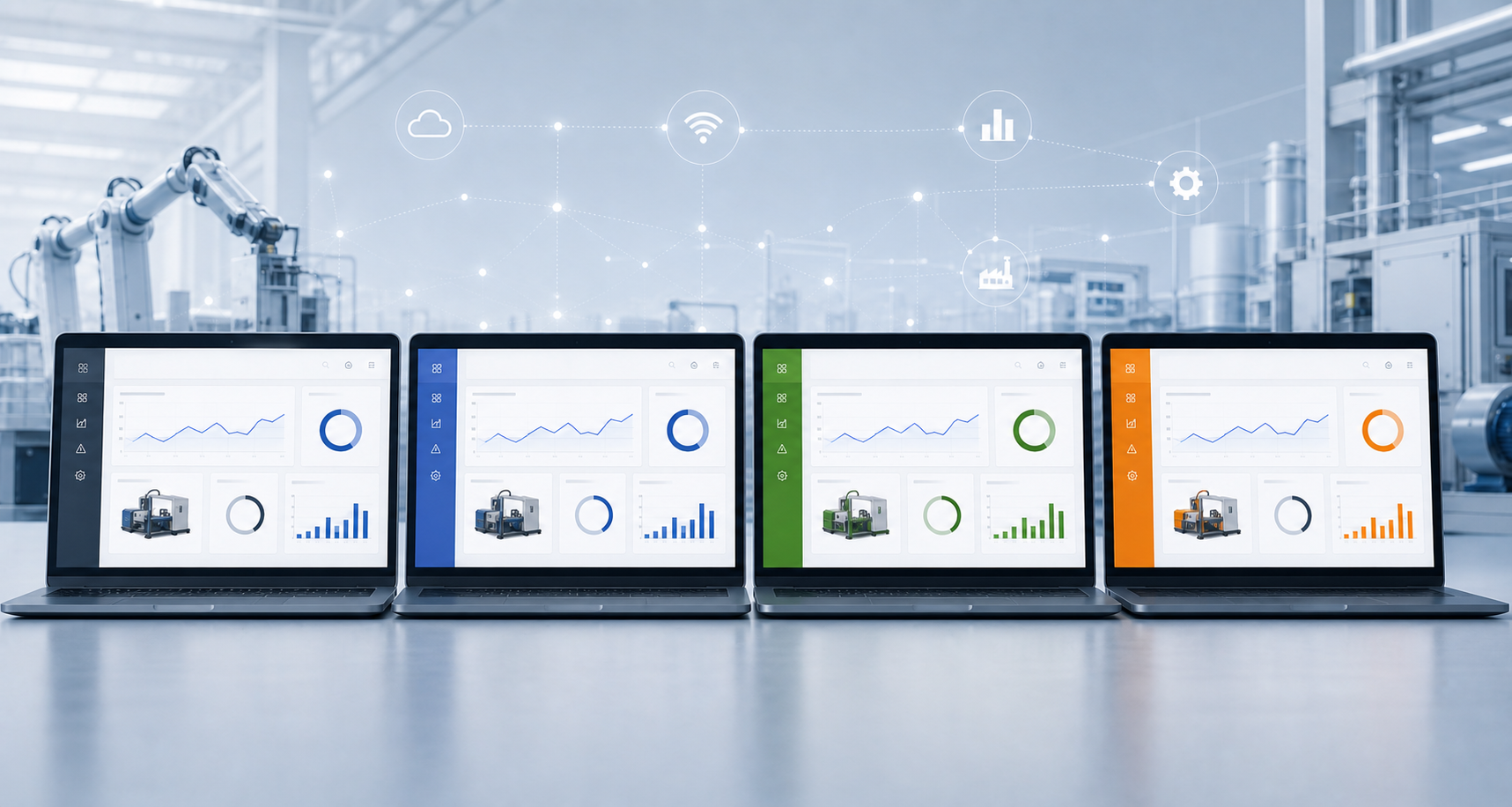
A white-label industrial Internet of Things (IIoT) platform can give machine builders a branded environment for secure remote service, machine monitoring, performance analytics, and other digital services. Depending on the platform, OEMs can configure applications, dashboards, workflows, user experiences, and integrations around their equipment and service model. The technology comes from a specialist. The customer experience belongs to the OEM.
Why white labeling is about more than branding
Industrial OEMs have spent decades building customer relationships around their machines. Their customers know who designed the equipment, who supports it, and who to call when something goes wrong. Connected services extend that relationship beyond installation and traditional maintenance. Every time a customer logs into a machine monitoring portal, requests remote technical support, or reviews equipment performance, that interaction becomes part of their experience with the OEM. The question is whether that digital experience feels like a natural extension of the machine builder's business or an entirely separate product.
This becomes especially important as OEMs expand their digital service offerings, particularly organizations that have grown through acquisitions or operate across multiple equipment brands and business units. One division may have developed its own software, another may use a third-party remote access tool, and a third may already offer branded monitoring services. Individually, those solutions may work well. Collectively, however, they can create inconsistent customer experiences, disconnected machine data, and a growing technology maintenance burden.
A white-label strategy provides an opportunity to establish a more consistent technology foundation while maintaining the flexibility different business units need. Rather than forcing every product line into the same customer-facing experience, OEMs can support multiple brands, applications, and service models using shared underlying technology. More importantly, they can focus their resources on developing services that differentiate their business instead of maintaining the software infrastructure behind them.
Build, resell, or white label: three ways to launch connected services
There is no single approach that makes sense for every equipment manufacturer. The right choice depends on existing technical capabilities, investment priorities, deployment timelines, and how much control the OEM wants over its digital service business.
- Build internally. Developing a proprietary platform gives an OEM direct control over its software architecture, features, and roadmap. For organizations with substantial software engineering resources and highly specialized requirements, this can be a reasonable choice. The trade-off is that software development becomes an ongoing responsibility, including cybersecurity, cloud infrastructure, integrations, support, and continuous upgrades.
- Resell a partner's platform. Reselling allows OEMs to offer connected services with relatively little development effort. The technology is already available, and deployment can be comparatively fast. However, the third-party brand remains visible, and the OEM may have less control over the experience, differentiation, and long-term direction of the offering.
- White label an established platform. White labeling combines an OEM-branded customer experience with technology developed and supported by a specialist provider. It can significantly reduce the need for internal software development while giving the OEM flexibility to build services around its customers and equipment. The trade-off is that the OEM must choose its technology partner carefully, because the platform's reliability, security, and capabilities become part of the OEM's own reputation.
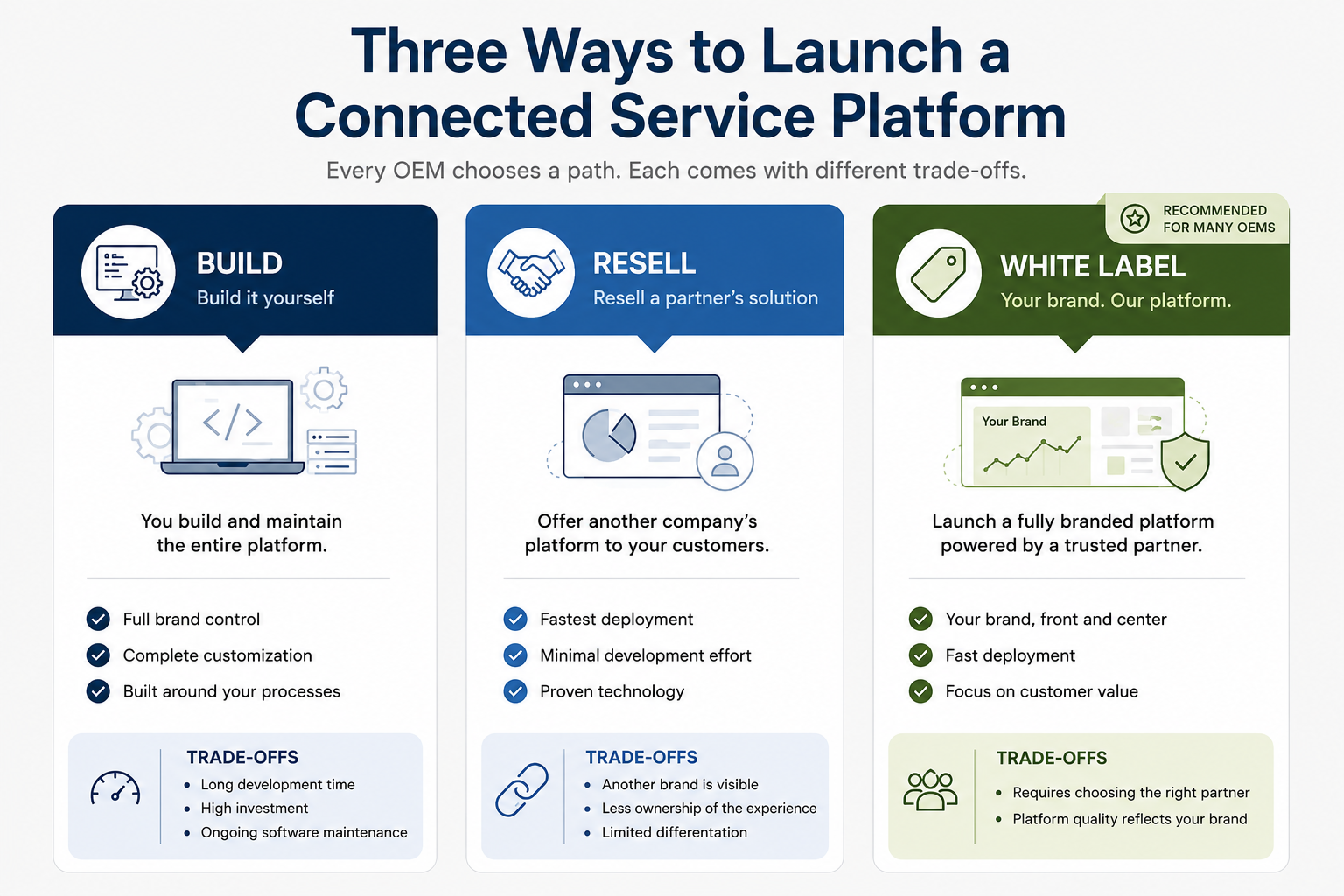
The distinction between these models is important. White labeling is not simply reselling software with a different logo. Done well, it allows the OEM to develop a recognizable service offering while relying on a proven technological foundation.
White-label IIoT platforms in action: five OEM examples


- BOBST — Helpline Plus: BOBST uses ei³'s white-label remote service technology to provide secure troubleshooting and machine diagnostics through its own branded support program, helping resolve equipment issues without unnecessary technician travel. Read the BOBST case study.
- Shibaura Machine — machiNetCloud: Shibaura Machine uses its machiNetCloud platform to deliver connected machinery capabilities, including equipment monitoring and predictive analytics, while maintaining its own branded digital experience. Explore machiNetCloud.
- Milacron — M-Powered: Milacron's branded IIoT offering combines remote service, machine monitoring, production analytics, and predictive capabilities to help plastics manufacturers improve machine performance and reduce downtime. Explore M-Powered.
- Coperion — C-BEYOND: Coperion's connected service offering uses the ei³ platform to deliver machine data insights that support production efficiency, equipment visibility, and continuous improvement. See C-BEYOND in action.
- KONO KOGS — KONOConnect: KONO KOGS delivers secure remote service through its branded KONOConnect solution, enabling technicians to diagnose and recover industrial control systems remotely, including restoring a controller program following a critical failure. Read the KONOConnect case study.
These programs serve different markets, machines, and service models, yet demonstrate the same principle: the technology foundation can be shared while the customer-facing offering remains distinctly the OEM's own. An OEM doesn't need to launch a complete suite of digital applications on day one, either. It might begin with secure remote support for its field service team, then expand into machine monitoring, performance reporting, or predictive maintenance as customer needs evolve.
How white labeling creates long-term value for OEMs
The immediate appeal of white labeling is often speed. An established technology foundation can eliminate years of development effort. But the longer-term value comes from the opportunities it creates for the OEM's service business.
Strengthening the customer relationship
When digital services are delivered under the OEM's brand, they become another point of contact between the machine builder and the equipment owner. That matters in industrial businesses where relationships continue for years or decades after the original equipment sale. Instead of engaging primarily when something breaks, the OEM can offer ongoing monitoring, performance insights, proactive service, and continuous support.
White labeling doesn't automatically give the OEM ownership of all customer data or commercial rights; those responsibilities depend on the agreement. But it can support an OEM-led service experience in which the equipment manufacturer remains the customer's primary service partner.
Expanding aftermarket revenue opportunities
Connected services can create new ways to generate value throughout a machine's operating life. Remote service subscriptions, advanced monitoring, performance analytics, predictive maintenance, and premium support programs can all become part of an OEM's aftermarket portfolio.
Not every capability needs to be monetized separately. Some may strengthen customer retention, improve warranty management, or help differentiate new equipment sales. The advantage of a white-label platform is that these offerings can be developed around the OEM's commercial model rather than limited to a generic technology reseller's packaging.
Scaling across products, regions, and business units
Large industrial organizations rarely have a perfectly standardized equipment portfolio. Different machine generations may use different controls, acquisitions introduce new product lines, and regional service organizations often follow their own workflows. A flexible IIoT platform can help establish consistency across that complexity, connecting different types of machines and supporting multiple service teams while allowing appropriate customization.
For OEMs managing hundreds or thousands of machines across different locations, that scalability is more than an IT concern. It directly affects the cost and practicality of delivering connected services to a growing installed base.
What should OEMs look for in a white-label IIoT partner?
White labeling doesn't eliminate technical responsibility; it changes how that responsibility is shared. Because customers associate the service with the OEM's brand, the reliability, security, and capabilities of the underlying platform become critically important.
Before selecting a technology partner, machine builders should evaluate six areas:
- Industrial cybersecurity: Look for controlled remote access, strong authentication, machine-level permissions, auditability, and an architecture designed for industrial environments. Clarify how security responsibilities, vulnerability management, and incident response are divided between the OEM and provider
- Compatibility with the installed base: Evaluate connectivity options for different controllers, protocols, machine generations, and customer network environments. A platform that supports existing equipment as well as new machines creates a much larger opportunity for aftermarket services
- Branding and customization: Understand how far customization extends, including branded applications, dashboards, workflows, domains, and customer communications. Consider whether different divisions or product lines can maintain their identities while sharing a common foundation
- Application capabilities: Secure remote access may be the starting point, but consider whether the platform can also support machine monitoring, production analytics, maintenance, quality, and other services without requiring an entirely new technology stack
- Data access and integrations: Clarify who can access machine data, how permissions are managed, and how information can be integrated with CRM, ERP, service management, or other enterprise systems. Data rights, portability, and exit provisions should be explicitly addressed
- Long-term platform development: Ask how frequently the platform is updated, how new capabilities are introduced, and how the partner supports evolving cybersecurity and compliance requirements
Ultimately, the strongest white-label partnership is one in which both companies contribute what they do best, with clear accountability for the experience delivered to the customer.
Do OEMs need to become software companies to offer digital services?
Not necessarily. An industrial OEM's competitive advantage usually comes from its equipment expertise, application knowledge, manufacturing processes, and understanding of its customers' operations. A connected service platform should help extend those strengths, not distract from them. With a white-label approach, the OEM can concentrate on helping customers get more value from their equipment while a technology partner maintains the underlying software.
At ei³, that's how we approach our partnerships with machine builders. We provide secure industrial connectivity, IIoT applications, and the technology foundation that OEMs can adapt and deliver under their own brands. That includes more than remote access: the platform supports machine monitoring, production intelligence, downtime analysis, maintenance, and other applications that turn connected equipment into an ongoing source of operational value.
The OEM brings the expertise that makes those services meaningful to its customers. Neither company has to become the other's business.
The bigger picture: your brand should extend beyond the machine
White labeling isn't simply a branding checkbox. It's a strategic choice about how an OEM wants to deliver services, maintain customer relationships, and create value throughout the equipment lifecycle.
Building internally will make sense for some organizations, while reselling is a practical starting point for others. But for OEMs that want the benefits of a branded service business without taking on the full responsibility of developing and maintaining a software platform, white labeling deserves serious consideration. The most effective partnerships aren't about making the technology provider more visible; they're about making the OEM's service offering stronger.
After all, customers aren't buying a software architecture. They're buying the confidence that the company behind their equipment can help them keep it performing. And that's exactly where the OEM's brand belongs.
ABOUT THE AUTHOR
Lauren Markofsky is the Marketing Director at ei3, where she leads marketing strategy, product positioning, and communications. Working closely with customers, product teams, and technical experts, Lauren specializes in translating complex industrial technologies into clear, practical guidance for OEMs and manufacturers.